
CONTACT US
SEARCH WHAT YOU WANT
For warehouses, factories, office buildings, shopping malls, and other commercial facilities, implementation requires coordination between equipment, infrastructure, cleaning personnel, and daily operations.
A structured deployment process helps identify potential problems before they affect cleaning performance. It also provides measurable criteria for evaluating whether the robot is ready for regular operation.
A site assessment determines whether the facility can support the robot's intended cleaning tasks and operating conditions.
The first step is to document the actual cleaning environment rather than relying solely on building floor area.
Different floor materials and surface conditions influence cleaning performance.
During the initial inspection, record:
Floor materials, including concrete, epoxy, tile, marble, and wood.
Surface unevenness, joints, slopes, and floor transitions.
Dust accumulation and typical debris.
Areas requiring sweeping, vacuuming, scrubbing, or dust mopping.
Locations where wet cleaning is restricted.
Areas requiring manual cleaning.
For example, a warehouse may have concrete floors with dust and packaging debris, while a shopping mall may contain polished tiles and multiple floor transitions.
The cleaning method should match the surface and the type of contamination. A robot designed for routine dust collection should not automatically be assigned to handle sticky spills or specialist cleaning tasks.
Navigation suitability is one of the most important deployment considerations.
Measure the narrowest passage, doorway, turning area, and available space around furniture or machinery.
Also identify:
Fixed obstacles such as columns and shelves.
Movable obstacles such as carts and pallets.
Automatic doors and access gates.
Ramps and changes in floor elevation.
High-traffic intersections.
Restricted or hazardous areas.
The Singapore NEA Guide on Specifications for Outcome-Based Cleaning Contracts (2026) distinguishes premises by their suitability for autonomous cleaning. Open atriums and corridors generally provide better operating conditions than crowded spaces with numerous obstacles.
A route that works during an empty facility inspection may become unsuitable during normal operations.
Observe the facility during representative working periods.
| Assessment Factor | What to Record |
|---|---|
| Pedestrian traffic | Peak and quiet periods |
| Vehicle movement | Forklifts, carts, and AGVs |
| Cleaning windows | Available operating periods |
| Access restrictions | Locked doors and controlled zones |
| Route conflicts | Intersections and shared pathways |
| Manual intervention | Areas requiring staff assistance |
In office buildings, consider employee movement and meeting schedules. In shopping malls, public traffic may require different routes at different times.
The operating schedule should reflect the facility's real workflow rather than an idealized demonstration environment.
Once the cleaning areas and routes have been assessed, the next step is checking whether the facility has the infrastructure required for reliable operation.
A charging location should be accessible without obstructing pedestrian or vehicle movement.
Check the following:
Available electrical outlets and power supply.
Sufficient space for the robot and charging dock.
Stable floor conditions around the charging position.
Protection from water, dust, and accidental impacts.
Convenient access for routine maintenance.
Safe storage for consumables and accessories.
For facilities with long operating hours, charging arrangements should be coordinated with the cleaning schedule.
A robot that must travel through several restricted zones to reach its charging location may lose valuable operating time.
Connected cleaning robots may rely on network access for remote monitoring, task management, map synchronization, and reporting.
Before deployment, verify:
Wi-Fi coverage throughout the intended operating areas.
Stable network access near charging locations.
Compatibility with existing access-control systems.
Elevator control requirements, if applicable.
Availability of authorized user accounts.
Remote monitoring and reporting permissions.
Multi-floor buildings may require additional coordination with building management.
The NEA's 2026 guidance also identifies remotely operated lifts and doors, adequate maneuvering space, stable Wi-Fi, and charging infrastructure as factors supporting autonomous cleaning.
After the site is prepared, implementation moves into configuration and operational testing.
A deployment should not be considered complete simply because the robot can navigate one route. It must also demonstrate repeatable cleaning performance under representative conditions.
The first configuration stage involves scanning the facility and creating a digital map.
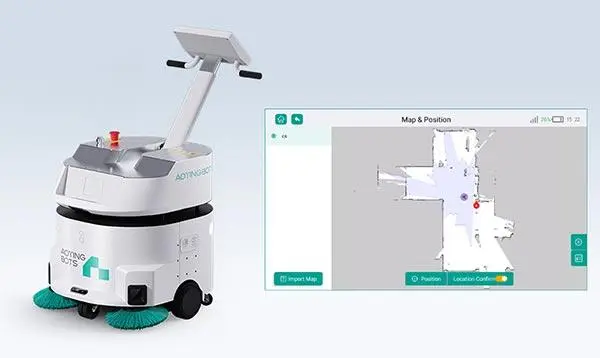
Divide the facility into manageable cleaning zones.
Typical examples include:
Warehouse aisles and loading areas.
Factory production and auxiliary areas.
Office corridors and reception spaces.
Shopping mall public areas.
Hotel lobbies and shared spaces.
Define restricted zones, charging locations, cleaning boundaries, and designated routes.
Where the robot supports map editing and incremental updates, changes can be made when furniture, equipment, or operational layouts change.
Avoid creating unnecessarily complicated routes. A simpler route with fewer interruptions may produce more consistent results.
Cleaning settings should reflect the floor condition and operational requirements.
Depending on the equipment, configuration may include:
Cleaning mode.
Travel speed.
Cleaning intensity.
Operating schedule.
Route sequence.
Restricted areas.
Automatic charging arrangements.
Task reporting settings.
For example, a quiet office environment may require slower operation and carefully scheduled routes. A warehouse may prioritize coverage across larger open areas while avoiding forklift-intensive periods.
The selected settings should be tested rather than assumed to be suitable based on default factory configurations.
A pilot test verifies whether the equipment performs as expected in the actual facility.
Use representative routes that include different floor surfaces, narrow passages, obstacles, and normal traffic conditions.
Record the following measurements:
| Test Item | Evaluation Method |
|---|---|
| Cleaning coverage | Completed area versus assigned area |
| Navigation | Route completion and positioning stability |
| Obstacle avoidance | Response to fixed and moving obstacles |
| Cleaning quality | Visual inspection of completed areas |
| Battery performance | Actual operating time and charging needs |
| Intervention frequency | Number of manual recoveries |
| Downtime | Time lost to interruptions or maintenance |
| Staff workload | Time required for daily operation and servicing |
Actual productivity can be affected by route complexity, furniture, debris, charging, and operator intervention.
The AotingBots distribution center cleaning automation guide also discusses zone planning, scheduling around facility operations, and testing equipment before expanding deployment.
A robot can complete its initial demonstration successfully but still encounter problems during daily operation.
The handover stage should establish clear responsibilities for cleaning, inspection, maintenance, and technical support.
Cleaning personnel should understand how to operate and maintain the equipment.
Training should cover:
Starting and stopping cleaning tasks.
Selecting operating modes.
Responding to navigation alerts.
Emptying waste containers and replacing consumables.
Cleaning sensors and checking brushes.
Charging and battery management.
Emergency stopping and manual recovery.
Reporting equipment faults.
Assign an operational contact responsible for daily checks and communication with technical support.
A short operating procedure should also explain how staff handle unexpected obstacles, spills, and areas requiring manual cleaning.
Deployment performance should be reviewed after the initial implementation period.
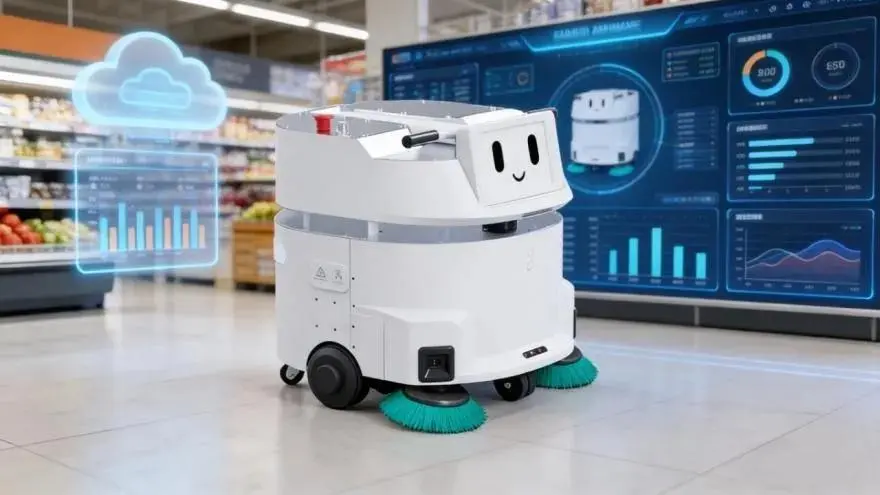
Compare actual operating data against the original site assessment.
Useful indicators include:
Daily completed cleaning area.
Scheduled task completion rate.
Average operating time.
Manual intervention frequency.
Charging and downtime.
Consumable replacement frequency.
Cleaning inspection results.
If performance falls below expectations, investigate the cause before changing equipment settings.
For example, repeated route interruptions may indicate a layout issue rather than a navigation system failure. Frequent charging interruptions may indicate that the cleaning schedule exceeds available operating endurance.
A structured review helps distinguish configuration problems from equipment limitations.
The equipment selected for deployment should match the site's physical layout, cleaning workload, and infrastructure.
The AotingBots SW55 A waterless commercial cleaning robot is designed for medium and small commercial environments.
Its four cleaning functions include sweeping, vacuuming, scrubbing, and dust mopping.
| Parameter | SW55 A |
|---|---|
| Dimensions | 615 × 585 × 650 mm |
| Robot weight | 91 kg |
| Cleaning efficiency | 1,200 m²/h |
| Cleaning path | 615–705 mm |
| Battery capacity | 52 Ah |
| Hard‑floor endurance | Up to 12 hours |
| Silent‑mode endurance | Up to 16.5 hours |
| Charging time | 2.5 hours |
| Maximum mapping area | 40,000 m² |
| Noise level | ≤62 dB(A) |
| Trash bin capacity | 4 L |
| Dustbag capacity | 7.5 L |
These manufacturer-published specifications provide useful reference points during site assessment. Actual coverage and operating endurance depend on facility conditions and cleaning configurations.
Several features are particularly relevant to deployment planning.
Compact dimensions: The 615 mm body width provides a starting point for checking passage clearance. Buyers should also account for turning space and side-brush clearance.
Mapping and navigation: The robot supports 360-degree laser and multi-sensor fusion positioning, real-time map updates, and a maximum mapping area of 40,000 m².
Charging arrangements: The standard charger has published dimensions of 200 × 330 × 440 mm. A dedicated location should be included in the site layout.
Building integration: Elevator control, access gates, and access-control integration are supported, subject to compatibility with existing building systems.
Maintenance planning: The published 4 L waste bin and 7.5 L dustbag capacities should be considered when estimating daily emptying and servicing requirements.
The SW55 A is listed for applications including offices, hotels, shopping malls, residential communities, and conference centers.
For facilities evaluating this model, the AotingBots commercial cleaning robot range provides additional product information.
The manufacturer's commercial building cleaning robot selection guide also discusses mapping, elevator integration, access control, remote task monitoring, and site trials.
A suitable deployment plan should ultimately connect these technical capabilities with the facility's actual cleaning requirements.
Deployment time depends on facility size, floor layout, infrastructure, and integration requirements. A simple single-floor site may require less configuration than a multi-floor building with controlled access and complex routes.
Prepare floor plans, floor materials, cleaning areas, passage widths, operating schedules, obstacle locations, charging arrangements, and network information. These details help identify potential deployment limitations.
Requirements depend on the model and its functions. Wi-Fi may support remote monitoring, task management, and reporting. Buyers should confirm which functions require continuous connectivity and which remain available offline.
Yes, if the equipment is suitable for the environment and its operating routes are properly configured. Traffic patterns, intersections, speed settings, obstacle detection, and restricted zones should be evaluated during testing.
A pilot reveals practical issues that specifications cannot fully predict. It helps verify cleaning coverage, navigation, battery performance, manual intervention, and compatibility with daily operations.
Maps should be reviewed whenever significant layout changes occur. New furniture, storage equipment, temporary partitions, or modified access routes may require map adjustments and route testing.
The handover should include operating instructions, approved cleaning maps, task schedules, operator training, maintenance procedures, emergency-stop instructions, warranty information, and technical support contacts.
That depends on the usable cleaning area, operating window, route complexity, battery endurance, and cleaning frequency. Theoretical cleaning efficiency alone is insufficient to determine the required fleet size.
1. Singapore NEA – Guide on Specifications for Outcome-Based Cleaning Contracts, 2026 — Site suitability, charging infrastructure, network coverage, and autonomous cleaning deployment.
2. Technical Guidelines for Use of Autonomous Mobile Robots in Commercial Buildings — Building integration, robot coordination, and autonomous operation considerations.
3. AotingBots SW55 A – Official Product Specifications — Technical parameters, cleaning functions, mapping, and integration capabilities.
4. AotingBots – Distribution Center Cleaning Automation Guide — Cleaning zone planning, operating schedules, and pilot testing.
5. AotingBots – Autonomous Cleaning Robot for Commercial Buildings — Building integration, navigation, monitoring, and selection considerations.
For warehouses, factories, office buildings, shopping malls, and other commercial facilities, implementation requires coordination between equipment, infrastructure, cleaning personnel, and daily operations.
A structured deployment process helps identify potential problems before they affect cleaning performance. It also provides measurable criteria for evaluating whether the robot is ready for regular operation.
A site assessment determines whether the facility can support the robot's intended cleaning tasks and operating conditions.
The first step is to document the actual cleaning environment rather than relying solely on building floor area.
Different floor materials and surface conditions influence cleaning performance.
During the initial inspection, record:
Floor materials, including concrete, epoxy, tile, marble, and wood.
Surface unevenness, joints, slopes, and floor transitions.
Dust accumulation and typical debris.
Areas requiring sweeping, vacuuming, scrubbing, or dust mopping.
Locations where wet cleaning is restricted.
Areas requiring manual cleaning.
For example, a warehouse may have concrete floors with dust and packaging debris, while a shopping mall may contain polished tiles and multiple floor transitions.
The cleaning method should match the surface and the type of contamination. A robot designed for routine dust collection should not automatically be assigned to handle sticky spills or specialist cleaning tasks.
Navigation suitability is one of the most important deployment considerations.
Measure the narrowest passage, doorway, turning area, and available space around furniture or machinery.
Also identify:
Fixed obstacles such as columns and shelves.
Movable obstacles such as carts and pallets.
Automatic doors and access gates.
Ramps and changes in floor elevation.
High-traffic intersections.
Restricted or hazardous areas.
The Singapore NEA Guide on Specifications for Outcome-Based Cleaning Contracts (2026) distinguishes premises by their suitability for autonomous cleaning. Open atriums and corridors generally provide better operating conditions than crowded spaces with numerous obstacles.
A route that works during an empty facility inspection may become unsuitable during normal operations.
Observe the facility during representative working periods.
| Assessment Factor | What to Record |
|---|---|
| Pedestrian traffic | Peak and quiet periods |
| Vehicle movement | Forklifts, carts, and AGVs |
| Cleaning windows | Available operating periods |
| Access restrictions | Locked doors and controlled zones |
| Route conflicts | Intersections and shared pathways |
| Manual intervention | Areas requiring staff assistance |
In office buildings, consider employee movement and meeting schedules. In shopping malls, public traffic may require different routes at different times.
The operating schedule should reflect the facility's real workflow rather than an idealized demonstration environment.
Once the cleaning areas and routes have been assessed, the next step is checking whether the facility has the infrastructure required for reliable operation.
A charging location should be accessible without obstructing pedestrian or vehicle movement.
Check the following:
Available electrical outlets and power supply.
Sufficient space for the robot and charging dock.
Stable floor conditions around the charging position.
Protection from water, dust, and accidental impacts.
Convenient access for routine maintenance.
Safe storage for consumables and accessories.
For facilities with long operating hours, charging arrangements should be coordinated with the cleaning schedule.
A robot that must travel through several restricted zones to reach its charging location may lose valuable operating time.
Connected cleaning robots may rely on network access for remote monitoring, task management, map synchronization, and reporting.
Before deployment, verify:
Wi-Fi coverage throughout the intended operating areas.
Stable network access near charging locations.
Compatibility with existing access-control systems.
Elevator control requirements, if applicable.
Availability of authorized user accounts.
Remote monitoring and reporting permissions.
Multi-floor buildings may require additional coordination with building management.
The NEA's 2026 guidance also identifies remotely operated lifts and doors, adequate maneuvering space, stable Wi-Fi, and charging infrastructure as factors supporting autonomous cleaning.
After the site is prepared, implementation moves into configuration and operational testing.
A deployment should not be considered complete simply because the robot can navigate one route. It must also demonstrate repeatable cleaning performance under representative conditions.
The first configuration stage involves scanning the facility and creating a digital map.
Divide the facility into manageable cleaning zones.
Typical examples include:
Warehouse aisles and loading areas.
Factory production and auxiliary areas.
Office corridors and reception spaces.
Shopping mall public areas.
Hotel lobbies and shared spaces.
Define restricted zones, charging locations, cleaning boundaries, and designated routes.
Where the robot supports map editing and incremental updates, changes can be made when furniture, equipment, or operational layouts change.
Avoid creating unnecessarily complicated routes. A simpler route with fewer interruptions may produce more consistent results.
Cleaning settings should reflect the floor condition and operational requirements.
Depending on the equipment, configuration may include:
Cleaning mode.
Travel speed.
Cleaning intensity.
Operating schedule.
Route sequence.
Restricted areas.
Automatic charging arrangements.
Task reporting settings.
For example, a quiet office environment may require slower operation and carefully scheduled routes. A warehouse may prioritize coverage across larger open areas while avoiding forklift-intensive periods.
The selected settings should be tested rather than assumed to be suitable based on default factory configurations.
A pilot test verifies whether the equipment performs as expected in the actual facility.
Use representative routes that include different floor surfaces, narrow passages, obstacles, and normal traffic conditions.
Record the following measurements:
| Test Item | Evaluation Method |
|---|---|
| Cleaning coverage | Completed area versus assigned area |
| Navigation | Route completion and positioning stability |
| Obstacle avoidance | Response to fixed and moving obstacles |
| Cleaning quality | Visual inspection of completed areas |
| Battery performance | Actual operating time and charging needs |
| Intervention frequency | Number of manual recoveries |
| Downtime | Time lost to interruptions or maintenance |
| Staff workload | Time required for daily operation and servicing |
Actual productivity can be affected by route complexity, furniture, debris, charging, and operator intervention.
The AotingBots distribution center cleaning automation guide also discusses zone planning, scheduling around facility operations, and testing equipment before expanding deployment.
A robot can complete its initial demonstration successfully but still encounter problems during daily operation.
The handover stage should establish clear responsibilities for cleaning, inspection, maintenance, and technical support.
Cleaning personnel should understand how to operate and maintain the equipment.
Training should cover:
Starting and stopping cleaning tasks.
Selecting operating modes.
Responding to navigation alerts.
Emptying waste containers and replacing consumables.
Cleaning sensors and checking brushes.
Charging and battery management.
Emergency stopping and manual recovery.
Reporting equipment faults.
Assign an operational contact responsible for daily checks and communication with technical support.
A short operating procedure should also explain how staff handle unexpected obstacles, spills, and areas requiring manual cleaning.
Deployment performance should be reviewed after the initial implementation period.
Compare actual operating data against the original site assessment.
Useful indicators include:
Daily completed cleaning area.
Scheduled task completion rate.
Average operating time.
Manual intervention frequency.
Charging and downtime.
Consumable replacement frequency.
Cleaning inspection results.
If performance falls below expectations, investigate the cause before changing equipment settings.
For example, repeated route interruptions may indicate a layout issue rather than a navigation system failure. Frequent charging interruptions may indicate that the cleaning schedule exceeds available operating endurance.
A structured review helps distinguish configuration problems from equipment limitations.
The equipment selected for deployment should match the site's physical layout, cleaning workload, and infrastructure.
The AotingBots SW55 A waterless commercial cleaning robot is designed for medium and small commercial environments.
Its four cleaning functions include sweeping, vacuuming, scrubbing, and dust mopping.
| Parameter | SW55 A |
|---|---|
| Dimensions | 615 × 585 × 650 mm |
| Robot weight | 91 kg |
| Cleaning efficiency | 1,200 m²/h |
| Cleaning path | 615–705 mm |
| Battery capacity | 52 Ah |
| Hard‑floor endurance | Up to 12 hours |
| Silent‑mode endurance | Up to 16.5 hours |
| Charging time | 2.5 hours |
| Maximum mapping area | 40,000 m² |
| Noise level | ≤62 dB(A) |
| Trash bin capacity | 4 L |
| Dustbag capacity | 7.5 L |
These manufacturer-published specifications provide useful reference points during site assessment. Actual coverage and operating endurance depend on facility conditions and cleaning configurations.
Several features are particularly relevant to deployment planning.
Compact dimensions: The 615 mm body width provides a starting point for checking passage clearance. Buyers should also account for turning space and side-brush clearance.
Mapping and navigation: The robot supports 360-degree laser and multi-sensor fusion positioning, real-time map updates, and a maximum mapping area of 40,000 m².
Charging arrangements: The standard charger has published dimensions of 200 × 330 × 440 mm. A dedicated location should be included in the site layout.
Building integration: Elevator control, access gates, and access-control integration are supported, subject to compatibility with existing building systems.
Maintenance planning: The published 4 L waste bin and 7.5 L dustbag capacities should be considered when estimating daily emptying and servicing requirements.
The SW55 A is listed for applications including offices, hotels, shopping malls, residential communities, and conference centers.
For facilities evaluating this model, the AotingBots commercial cleaning robot range provides additional product information.
The manufacturer's commercial building cleaning robot selection guide also discusses mapping, elevator integration, access control, remote task monitoring, and site trials.
A suitable deployment plan should ultimately connect these technical capabilities with the facility's actual cleaning requirements.
Deployment time depends on facility size, floor layout, infrastructure, and integration requirements. A simple single-floor site may require less configuration than a multi-floor building with controlled access and complex routes.
Prepare floor plans, floor materials, cleaning areas, passage widths, operating schedules, obstacle locations, charging arrangements, and network information. These details help identify potential deployment limitations.
Requirements depend on the model and its functions. Wi-Fi may support remote monitoring, task management, and reporting. Buyers should confirm which functions require continuous connectivity and which remain available offline.
Yes, if the equipment is suitable for the environment and its operating routes are properly configured. Traffic patterns, intersections, speed settings, obstacle detection, and restricted zones should be evaluated during testing.
A pilot reveals practical issues that specifications cannot fully predict. It helps verify cleaning coverage, navigation, battery performance, manual intervention, and compatibility with daily operations.
Maps should be reviewed whenever significant layout changes occur. New furniture, storage equipment, temporary partitions, or modified access routes may require map adjustments and route testing.
The handover should include operating instructions, approved cleaning maps, task schedules, operator training, maintenance procedures, emergency-stop instructions, warranty information, and technical support contacts.
That depends on the usable cleaning area, operating window, route complexity, battery endurance, and cleaning frequency. Theoretical cleaning efficiency alone is insufficient to determine the required fleet size.
1. Singapore NEA – Guide on Specifications for Outcome-Based Cleaning Contracts, 2026 — Site suitability, charging infrastructure, network coverage, and autonomous cleaning deployment.
2. Technical Guidelines for Use of Autonomous Mobile Robots in Commercial Buildings — Building integration, robot coordination, and autonomous operation considerations.
3. AotingBots SW55 A – Official Product Specifications — Technical parameters, cleaning functions, mapping, and integration capabilities.
4. AotingBots – Distribution Center Cleaning Automation Guide — Cleaning zone planning, operating schedules, and pilot testing.
5. AotingBots – Autonomous Cleaning Robot for Commercial Buildings — Building integration, navigation, monitoring, and selection considerations.
CONTACT US
we aim to become a global leader in manufacturer space service robotics and artificial intelligence.


