
CONTACT US
SEARCH WHAT YOU WANT
Choosing between commercial cleaning robot rental and purchase depends on how frequently the equipment will be used, how long the facility needs it, and who will manage maintenance and repairs. Rental can reduce initial financial commitment and provide flexibility for temporary operations, while purchasing may offer better long-term value for facilities with stable cleaning requirements.
For warehouses, shopping malls, factories, hotels, and commercial buildings, the decision should not be based on the equipment price alone. Businesses need to consider total cost of ownership (TCO), cleaning coverage, equipment utilization, service availability, and operational continuity.
Commercial cleaning robots are designed to automate repetitive floor-cleaning tasks. However, their financial value depends on how effectively they fit into daily facility operations.
A robot used every day in a large shopping mall has a different cost profile from one deployed occasionally in a temporary exhibition venue.
Before choosing an acquisition model, facility managers should evaluate:
Cleaning frequency: Daily, weekly, seasonal, or project-based.
Facility stability: Whether the cleaning area and operational requirements are likely to change.
Initial budget: Whether capital expenditure is available.
Maintenance resources: Whether an internal team can handle routine servicing.
Equipment utilization: How many hours the robot will operate each day.
Service requirements: Whether technical support and replacement equipment are available.
The most suitable option is the one that delivers consistent cleaning performance at an acceptable cost over the expected service period.
The main difference is equipment ownership and how operational costs are distributed.
With rental, a business pays for temporary or contracted use of equipment. With purchasing, the business owns the robot and assumes responsibility for its ongoing operation.
|
Evaluation Factor |
Rental |
Purchase |
|---|---|---|
|
Initial investment |
Usually lower |
Higher upfront expenditure |
|
Equipment ownership |
Rental provider |
Business |
|
Contract flexibility |
Depends on rental terms |
Greater control over usage |
|
Maintenance |
Depends on agreement |
Usually owner's responsibility |
|
Equipment upgrades |
May be easier at renewal |
Requires replacement or additional investment |
|
Long-term cost |
Recurring rental payments |
Purchase plus operating costs |
|
Best suited for |
Temporary or uncertain demand |
Stable, frequent operations |
It is important to distinguish short-term rental, financing leases, and Robotics-as-a-Service (RaaS).
Short-term rental: Equipment is used for a defined period and returned afterward.
Finance lease: The business makes scheduled payments under a longer-term financing agreement.
RaaS: A service-based arrangement that may combine equipment access, software, maintenance, and technical support into recurring payments.
The actual responsibilities depend on the contract rather than the name of the arrangement.
A useful comparison starts with total cost of ownership rather than the initial quotation.
For purchasing, the calculation should include:
Robot acquisition cost.
Delivery and installation.
Mapping and initial configuration.
Operator training.
Routine maintenance and replacement parts.
Battery replacement, where applicable.
Software or technical support fees.
Electricity and consumables.
Residual value at the end of the evaluation period.
For rental, businesses should check:
Monthly or daily rental charges.
Delivery and collection fees.
Installation and commissioning charges.
Maintenance coverage.
Insurance and damage responsibilities.
Usage restrictions.
Contract extension and early termination fees.
Charges for equipment downtime or replacement.
A lower rental payment does not automatically mean a lower total cost. Similarly, purchasing is not necessarily more economical if the robot remains unused for long periods.
Consider a facility evaluating a cleaning robot over 36 months.
The following example uses hypothetical figures to demonstrate the calculation. It is not an actual AotingBots quotation.
|
Cost Item |
Purchase |
Rental |
|---|---|---|
|
Initial equipment cost |
$18,000 |
$0 |
|
Monthly rental payment |
$0 |
$650 |
|
Monthly maintenance allowance |
$100 |
Included |
|
Monthly operating costs |
$80 |
$80 |
|
Evaluation period |
36 months |
36 months |
|
Estimated total |
$24,480 |
$26,280 |
In this example:
Purchase: $18,000 + ($100 × 36) + ($80 × 36) = $24,480.
Rental: ($650 × 36) + ($80 × 36) = $26,280.
Purchasing costs $1,800 less over three years under these assumptions.
However, this calculation excludes financing costs, insurance, installation differences, equipment downtime, and potential resale value. Actual results will depend on the contract and operating conditions.
The U.S. Department of Energy's life-cycle cost guidance provides a useful framework for evaluating acquisition and operating expenses over an equipment's useful life.
The decision becomes clearer when the cleaning workload and expected equipment usage are considered.
Rental can be practical when cleaning demand changes throughout the year.
Examples include:
Exhibition halls preparing for major events.
Shopping centers experiencing seasonal traffic increases.
Construction projects requiring temporary facility cleaning.
Warehouses operating during short-term peak seasons.
Businesses testing robotic cleaning before expanding automation.
In these situations, purchasing equipment may create unnecessary long-term commitments.
A rental arrangement allows businesses to evaluate cleaning performance before deciding whether permanent deployment is justified.
Purchasing may be more suitable for facilities with predictable cleaning schedules and long-term operational requirements.
Typical examples include:
Manufacturing plants with daily floor-cleaning requirements.
Distribution centers operating multiple shifts.
Shopping malls with large public areas.
Hotels with recurring cleaning schedules.
Commercial buildings requiring routine maintenance.
When a robot operates regularly, the initial acquisition cost can be distributed across many cleaning cycles.
Businesses also retain greater control over equipment scheduling, configuration, and deployment.
Some facility managers are unsure whether autonomous cleaning will work effectively in their buildings.
A short-term rental or demonstration arrangement can help answer practical questions:
Can the robot navigate narrow aisles?
Can it operate around employees and visitors?
Does it cover the required cleaning area?
Are its operating hours sufficient?
Can it integrate with existing facility access systems?
A structured pilot can reduce the risk of purchasing equipment that does not match actual site conditions.
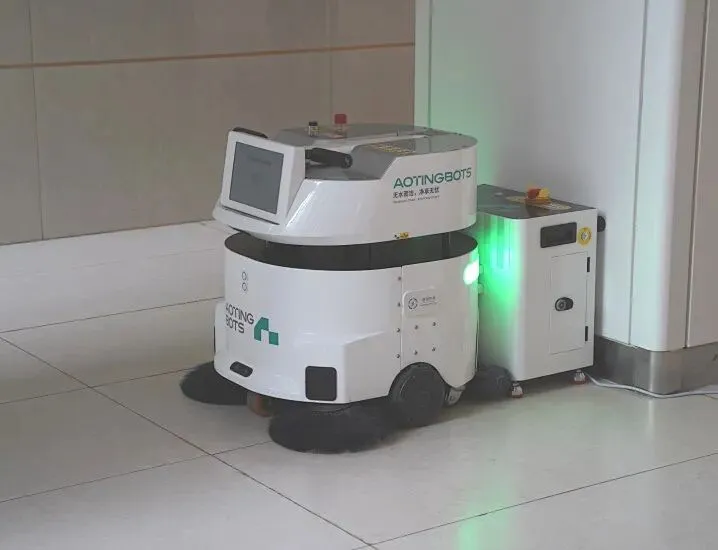
Acquisition method is only one part of the decision. The robot must also match the facility's floor area, cleaning requirements, and operating environment.
For example, a compact commercial cleaning robot may work well in office buildings and hotels, while larger equipment may be more appropriate for factories and exhibition halls.
Consider these operational factors before selecting a model:
|
Selection Factor |
What to Evaluate |
|---|---|
|
Cleaning efficiency |
Actual coverage under site conditions |
|
Cleaning width |
Available aisle space and open-floor coverage |
|
Battery endurance |
Required cleaning hours per shift |
|
Navigation |
Obstacles, traffic, elevators, and access restrictions |
|
Floor compatibility |
Carpet, wood, tile, marble, and other surfaces |
|
Maintenance |
Waste collection, brushes, filters, and servicing |
|
Monitoring |
Cleaning reports and remote task management |
Published cleaning efficiency should not be treated as guaranteed real-world output. Obstacles, furniture, traffic, route complexity, and cleaning frequency can affect actual coverage.
When comparing rental and purchase options, businesses should evaluate equipment specifications independently of the acquisition method.
AotingBots offers the SW55 A commercial waterless cleaning robot for facilities requiring automated floor-cleaning capabilities.
The AotingBots SW55 A commercial cleaning robot combines sweeping, vacuuming, scrubbing, and dust mopping functions.
Its published specifications include:
Cleaning efficiency: 1,200 m²/h.
Robot weight: 91 kg.
Cleaning path: 705 mm with the large side brush.
Battery capacity: 52 Ah.
Hard-floor endurance: Up to 12 hours.
Noise level: ≤62 dB(A).
Maximum mapping area: 40,000 m².
The compact design and elevator and access-control integration support deployment in hotels, office buildings, shopping malls, and other medium-sized commercial environments.
For facilities considering automation, the SW55 A provides a reference point for evaluating cleaning efficiency, battery endurance, navigation, and daily operating requirements.
Before selecting a model, buyers should compare the robot's specifications with their floor layout, cleaning schedule, and maintenance expectations.
You can explore the AotingBots commercial cleaning robot product range to learn more about its available cleaning solutions.
AotingBots' published product information describes equipment specifications and applications, but does not establish a standard rental program or rental pricing. Businesses interested in rental, leasing, or purchasing should confirm the available commercial arrangements directly through the AotingBots contact page.
Before committing to either option, facility managers should prepare a comparison based on actual cleaning requirements.
A practical evaluation process includes:
Measure the cleaning area: Identify open floors, narrow passages, obstacles, and restricted zones.
Define the cleaning schedule: Record the number of cleaning hours and shifts required.
Select a suitable model: Compare cleaning width, endurance, navigation, and floor compatibility.
Calculate the total cost: Include equipment, maintenance, consumables, energy, installation, and service.
Evaluate downtime risks: Confirm repair response times and replacement equipment arrangements.
Run a site demonstration: Check actual cleaning coverage and operational performance.
Review the contract: Examine warranty coverage, service obligations, ownership, renewal, and termination conditions.
A rental quotation should clearly identify what is included in the recurring payment. A purchase quotation should specify warranty coverage, spare parts availability, technical support, and ongoing maintenance costs.
For facilities with multiple locations, a hybrid approach may also be worth considering. Businesses can purchase robots for permanent sites while using rental equipment to manage temporary demand or pilot new applications.
Rental usually requires less initial investment, but recurring payments can increase the total cost over time. Purchasing may be more economical for facilities with consistent daily cleaning requirements.
A pilot period should be long enough to evaluate cleaning coverage, navigation, battery performance, maintenance requirements, and operator acceptance. The appropriate duration depends on facility complexity and operational schedules.
Not necessarily. Some rental agreements include preventive maintenance and repairs, while others charge these services separately. Businesses should confirm maintenance responsibilities and replacement equipment arrangements before signing.
Yes, depending on its design and configuration. Commercial cleaning robots can serve environments such as offices, hotels, shopping malls, and factories, provided their floor compatibility, dimensions, navigation, and cleaning capabilities match the site.
Purchasing can be worthwhile when equipment utilization is high and the facility has predictable cleaning requirements. Businesses should compare the purchase price, maintenance, operating expenses, expected service life, and potential resale value.
Review the rental period, payment structure, maintenance coverage, insurance, equipment replacement policy, software support, usage restrictions, and contract termination conditions.
U.S. Department of Energy – Life Cycle Costs for Acquisition — Life-cycle cost evaluation and ownership expenses.
Acquisition.gov – FAR 7.401 Equipment Acquisition Considerations — Equipment acquisition considerations.
AotingBots SW55 A – Product Specifications — Commercial cleaning capabilities and technical parameters.
AotingBots – Commercial Cleaning Robot Product Range — Product range and application information.
Choosing between commercial cleaning robot rental and purchase depends on how frequently the equipment will be used, how long the facility needs it, and who will manage maintenance and repairs. Rental can reduce initial financial commitment and provide flexibility for temporary operations, while purchasing may offer better long-term value for facilities with stable cleaning requirements.
For warehouses, shopping malls, factories, hotels, and commercial buildings, the decision should not be based on the equipment price alone. Businesses need to consider total cost of ownership (TCO), cleaning coverage, equipment utilization, service availability, and operational continuity.
Commercial cleaning robots are designed to automate repetitive floor-cleaning tasks. However, their financial value depends on how effectively they fit into daily facility operations.
A robot used every day in a large shopping mall has a different cost profile from one deployed occasionally in a temporary exhibition venue.
Before choosing an acquisition model, facility managers should evaluate:
Cleaning frequency: Daily, weekly, seasonal, or project-based.
Facility stability: Whether the cleaning area and operational requirements are likely to change.
Initial budget: Whether capital expenditure is available.
Maintenance resources: Whether an internal team can handle routine servicing.
Equipment utilization: How many hours the robot will operate each day.
Service requirements: Whether technical support and replacement equipment are available.
The most suitable option is the one that delivers consistent cleaning performance at an acceptable cost over the expected service period.
The main difference is equipment ownership and how operational costs are distributed.
With rental, a business pays for temporary or contracted use of equipment. With purchasing, the business owns the robot and assumes responsibility for its ongoing operation.
|
Evaluation Factor |
Rental |
Purchase |
|---|---|---|
|
Initial investment |
Usually lower |
Higher upfront expenditure |
|
Equipment ownership |
Rental provider |
Business |
|
Contract flexibility |
Depends on rental terms |
Greater control over usage |
|
Maintenance |
Depends on agreement |
Usually owner's responsibility |
|
Equipment upgrades |
May be easier at renewal |
Requires replacement or additional investment |
|
Long-term cost |
Recurring rental payments |
Purchase plus operating costs |
|
Best suited for |
Temporary or uncertain demand |
Stable, frequent operations |
It is important to distinguish short-term rental, financing leases, and Robotics-as-a-Service (RaaS).
Short-term rental: Equipment is used for a defined period and returned afterward.
Finance lease: The business makes scheduled payments under a longer-term financing agreement.
RaaS: A service-based arrangement that may combine equipment access, software, maintenance, and technical support into recurring payments.
The actual responsibilities depend on the contract rather than the name of the arrangement.
A useful comparison starts with total cost of ownership rather than the initial quotation.
For purchasing, the calculation should include:
Robot acquisition cost.
Delivery and installation.
Mapping and initial configuration.
Operator training.
Routine maintenance and replacement parts.
Battery replacement, where applicable.
Software or technical support fees.
Electricity and consumables.
Residual value at the end of the evaluation period.
For rental, businesses should check:
Monthly or daily rental charges.
Delivery and collection fees.
Installation and commissioning charges.
Maintenance coverage.
Insurance and damage responsibilities.
Usage restrictions.
Contract extension and early termination fees.
Charges for equipment downtime or replacement.
A lower rental payment does not automatically mean a lower total cost. Similarly, purchasing is not necessarily more economical if the robot remains unused for long periods.
Consider a facility evaluating a cleaning robot over 36 months.
The following example uses hypothetical figures to demonstrate the calculation. It is not an actual AotingBots quotation.
|
Cost Item |
Purchase |
Rental |
|---|---|---|
|
Initial equipment cost |
$18,000 |
$0 |
|
Monthly rental payment |
$0 |
$650 |
|
Monthly maintenance allowance |
$100 |
Included |
|
Monthly operating costs |
$80 |
$80 |
|
Evaluation period |
36 months |
36 months |
|
Estimated total |
$24,480 |
$26,280 |
In this example:
Purchase: $18,000 + ($100 × 36) + ($80 × 36) = $24,480.
Rental: ($650 × 36) + ($80 × 36) = $26,280.
Purchasing costs $1,800 less over three years under these assumptions.
However, this calculation excludes financing costs, insurance, installation differences, equipment downtime, and potential resale value. Actual results will depend on the contract and operating conditions.
The U.S. Department of Energy's life-cycle cost guidance provides a useful framework for evaluating acquisition and operating expenses over an equipment's useful life.
The decision becomes clearer when the cleaning workload and expected equipment usage are considered.
Rental can be practical when cleaning demand changes throughout the year.
Examples include:
Exhibition halls preparing for major events.
Shopping centers experiencing seasonal traffic increases.
Construction projects requiring temporary facility cleaning.
Warehouses operating during short-term peak seasons.
Businesses testing robotic cleaning before expanding automation.
In these situations, purchasing equipment may create unnecessary long-term commitments.
A rental arrangement allows businesses to evaluate cleaning performance before deciding whether permanent deployment is justified.
Purchasing may be more suitable for facilities with predictable cleaning schedules and long-term operational requirements.
Typical examples include:
Manufacturing plants with daily floor-cleaning requirements.
Distribution centers operating multiple shifts.
Shopping malls with large public areas.
Hotels with recurring cleaning schedules.
Commercial buildings requiring routine maintenance.
When a robot operates regularly, the initial acquisition cost can be distributed across many cleaning cycles.
Businesses also retain greater control over equipment scheduling, configuration, and deployment.
Some facility managers are unsure whether autonomous cleaning will work effectively in their buildings.
A short-term rental or demonstration arrangement can help answer practical questions:
Can the robot navigate narrow aisles?
Can it operate around employees and visitors?
Does it cover the required cleaning area?
Are its operating hours sufficient?
Can it integrate with existing facility access systems?
A structured pilot can reduce the risk of purchasing equipment that does not match actual site conditions.
Acquisition method is only one part of the decision. The robot must also match the facility's floor area, cleaning requirements, and operating environment.
For example, a compact commercial cleaning robot may work well in office buildings and hotels, while larger equipment may be more appropriate for factories and exhibition halls.
Consider these operational factors before selecting a model:
|
Selection Factor |
What to Evaluate |
|---|---|
|
Cleaning efficiency |
Actual coverage under site conditions |
|
Cleaning width |
Available aisle space and open-floor coverage |
|
Battery endurance |
Required cleaning hours per shift |
|
Navigation |
Obstacles, traffic, elevators, and access restrictions |
|
Floor compatibility |
Carpet, wood, tile, marble, and other surfaces |
|
Maintenance |
Waste collection, brushes, filters, and servicing |
|
Monitoring |
Cleaning reports and remote task management |
Published cleaning efficiency should not be treated as guaranteed real-world output. Obstacles, furniture, traffic, route complexity, and cleaning frequency can affect actual coverage.
When comparing rental and purchase options, businesses should evaluate equipment specifications independently of the acquisition method.
AotingBots offers the SW55 A commercial waterless cleaning robot for facilities requiring automated floor-cleaning capabilities.
The AotingBots SW55 A commercial cleaning robot combines sweeping, vacuuming, scrubbing, and dust mopping functions.
Its published specifications include:
Cleaning efficiency: 1,200 m²/h.
Robot weight: 91 kg.
Cleaning path: 705 mm with the large side brush.
Battery capacity: 52 Ah.
Hard-floor endurance: Up to 12 hours.
Noise level: ≤62 dB(A).
Maximum mapping area: 40,000 m².
The compact design and elevator and access-control integration support deployment in hotels, office buildings, shopping malls, and other medium-sized commercial environments.
For facilities considering automation, the SW55 A provides a reference point for evaluating cleaning efficiency, battery endurance, navigation, and daily operating requirements.
Before selecting a model, buyers should compare the robot's specifications with their floor layout, cleaning schedule, and maintenance expectations.
You can explore the AotingBots commercial cleaning robot product range to learn more about its available cleaning solutions.
AotingBots' published product information describes equipment specifications and applications, but does not establish a standard rental program or rental pricing. Businesses interested in rental, leasing, or purchasing should confirm the available commercial arrangements directly through the AotingBots contact page.
Before committing to either option, facility managers should prepare a comparison based on actual cleaning requirements.
A practical evaluation process includes:
Measure the cleaning area: Identify open floors, narrow passages, obstacles, and restricted zones.
Define the cleaning schedule: Record the number of cleaning hours and shifts required.
Select a suitable model: Compare cleaning width, endurance, navigation, and floor compatibility.
Calculate the total cost: Include equipment, maintenance, consumables, energy, installation, and service.
Evaluate downtime risks: Confirm repair response times and replacement equipment arrangements.
Run a site demonstration: Check actual cleaning coverage and operational performance.
Review the contract: Examine warranty coverage, service obligations, ownership, renewal, and termination conditions.
A rental quotation should clearly identify what is included in the recurring payment. A purchase quotation should specify warranty coverage, spare parts availability, technical support, and ongoing maintenance costs.
For facilities with multiple locations, a hybrid approach may also be worth considering. Businesses can purchase robots for permanent sites while using rental equipment to manage temporary demand or pilot new applications.
Rental usually requires less initial investment, but recurring payments can increase the total cost over time. Purchasing may be more economical for facilities with consistent daily cleaning requirements.
A pilot period should be long enough to evaluate cleaning coverage, navigation, battery performance, maintenance requirements, and operator acceptance. The appropriate duration depends on facility complexity and operational schedules.
Not necessarily. Some rental agreements include preventive maintenance and repairs, while others charge these services separately. Businesses should confirm maintenance responsibilities and replacement equipment arrangements before signing.
Yes, depending on its design and configuration. Commercial cleaning robots can serve environments such as offices, hotels, shopping malls, and factories, provided their floor compatibility, dimensions, navigation, and cleaning capabilities match the site.
Purchasing can be worthwhile when equipment utilization is high and the facility has predictable cleaning requirements. Businesses should compare the purchase price, maintenance, operating expenses, expected service life, and potential resale value.
Review the rental period, payment structure, maintenance coverage, insurance, equipment replacement policy, software support, usage restrictions, and contract termination conditions.
U.S. Department of Energy – Life Cycle Costs for Acquisition — Life-cycle cost evaluation and ownership expenses.
Acquisition.gov – FAR 7.401 Equipment Acquisition Considerations — Equipment acquisition considerations.
AotingBots SW55 A – Product Specifications — Commercial cleaning capabilities and technical parameters.
AotingBots – Commercial Cleaning Robot Product Range — Product range and application information.
CONTACT US
we aim to become a global leader in manufacturer space service robotics and artificial intelligence.


