Procuring an
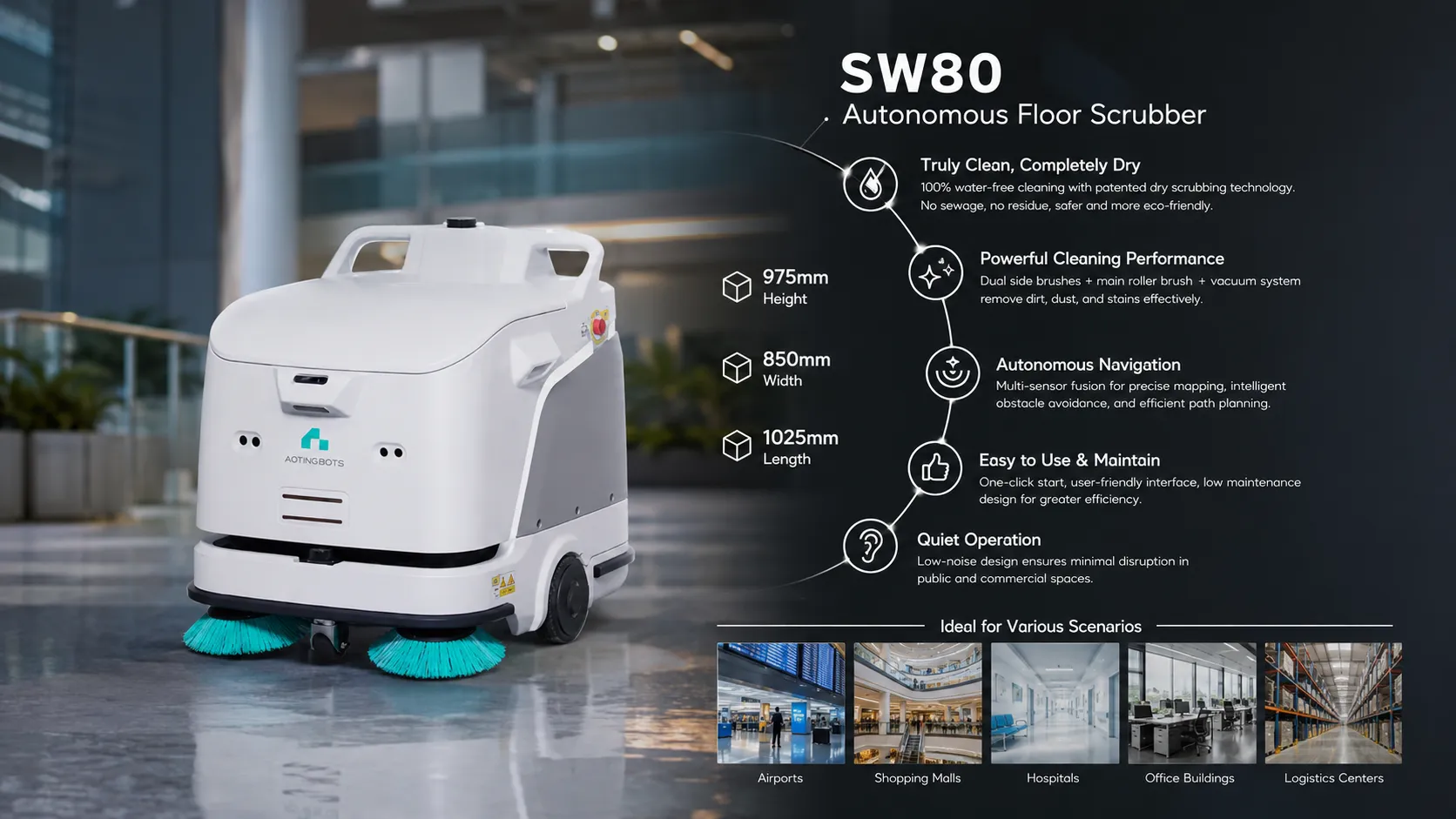
autonomous cleaning robot for industrial facilities is a capital decision that directly impacts labor cost, hygiene compliance, and operational uptime across the entire plant. For factory managers, warehouse operators, and facility service directors, the priority is not simply buying a machine that moves on its own. It is securing a robotic platform whose navigation safety, coverage efficiency, maintenance interval, and dust control can withstand dynamic industrial environments with forklifts, AGVs, pallets, and continuous debris generation. AotingBots answers this need with its SW80 A, a waterless cleaning robot specifically engineered for commercial and industrial environments, including factories, conference centers, exhibition halls, and large-format retail.
Why Industrial-Grade Autonomy Requires Compliance, Not Just Mobility
Any serious discussion about an autonomous cleaning robot for industrial facilities must begin with safety standards. ANSI/A3 R15.08-1-2020 (R2026) provides the safety requirements for industrial mobile robots (IMRs), emphasizing that manufacturers must design robots to operate with acceptable risk in a specified operating environment (SOE) documented by the manufacturer. The standard requires risk assessment as an iterative process and mandates key safety functions: protective stops, emergency stops, collision avoidance, speed control, and validated stopping distances.
Critically, R15.08 specifies that replanning of the path shall not introduce hazards, and presence-sensing safety functions may be suspended only under 300 mm/s. For cleaning robots operating alongside forklifts and personnel in industrial facilities, these requirements are not optional. They define the difference between a robot that merely navigates and one that can be trusted in a high-entropy environment.
The SW80 A is engineered around these principles. Its 360-degree laser and multi-sensor fusion positioning delivers centimeter-level accuracy, while dynamic map updating allows the robot to recalculate routes in real-time when obstacles appear. This sensor architecture directly addresses the collision avoidance and path replanning requirements defined in R15.08.
The Engineering Levers That Define Industrial Cleaning Performance
An autonomous cleaning robot for industrial facilities must balance five engineering variables:
- Coverage efficiency: The SW80 A delivers 1600 m²/h cleaning efficiency with an 850 mm cleaning path, operating at selectable speeds of 0.6 m/s, 0.45 m/s, or 0.3 m/s
- Endurance: 8 hours of continuous operation on hard flooring, extending to 12 hours in silent mode, powered by a 100 Ah battery with 4-hour charging time
- Mapping capacity: Up to 40,000 m² of mapped area with incremental map updating, enabling easy expansion of cleaning zones
- Edge cleaning: 0 cm edge cleaning distance, achieving complete coverage along walls and around machinery
- Dust control: 17 kPa maximum vacuum power with waterless cleaning technology that sweeps, vacuums, mops, and pushes dust in a single pass, capable of sweeping up to 40 mm of garbage
These parameters position the SW80 A specifically for industrial-scale deployment, where coverage area and autonomy duration matter more than consumer-grade convenience features.
How SW80 A Compares with Commercial Alternatives
For procurement managers, hard-parameter comparison reveals where the true advantages lie. The following tables contrast SW80 A with representative competitors in the global autonomous cleaning robot market.
Navigation and Operational Capability
|
Dimension
|
AotingBots SW80 A
|
Avidbots Neo 2W
|
Cleanfix RA660 Navi XL
|
Tenant T16AMR
|
|
Navigation approach
|
360° laser + multi-sensor fusion, SLAM
|
AI navigation for dynamic environments
|
Reliable navigation for large industrial areas
|
BrainOS autonomous navigation
|
|
Primary positioning
|
Centimeter-level accuracy
|
3D vision
|
Fleet-managed navigation
|
Proven autonomous floor scrubbing
|
|
Max. mapping area
|
40,000 m²
|
Warehouse-specific deployment
|
Large industrial areas
|
Complex site integration
|
|
Edge cleaning distance
|
0 cm
|
Not specified
|
Not specified
|
Not specified
|
|
Waterless cleaning
|
Yes.
|
No (wet scrubbing)
|
No (wet scrubbing)
|
No (wet scrubbing with ec-H₂O)
|
|
Max. noise level
|
≤62 dB(A)
|
Not specified
|
Not specified
|
Not specified
|
The SW80 A's waterless cleaning technology represents a distinct competitive advantage for industrial facilities. Unlike wet scrubbers from Avidbots, Cleanfix, and Tennant that introduce moisture to floors, the SW80 A's dry cleaning process prevents water leakage and protects industrial goods, packaging, and electronic equipment from moisture damage. This is particularly critical in warehouses storing cardboard packaging, paper products, and moisture-sensitive inventory.
Endurance and Maintenance Profile
|
Metric
|
AotingBots SW80 A
|
Typical competitor range (market reference)
|
|
Operation endurance
|
8h hard flooring, 12h silent mode
|
Continuous operation emphasized; the Tennant X6 ROVR is designed to clean up to 75,000 sq ft per cycle
|
|
Cleaning efficiency
|
1600 m²/h
|
Avidbots Neo 2W reduces labor up to 80%.
|
|
Maintenance interval
|
Once per week
|
Not specified across competitors
|
|
Dust control
|
17 kPa vacuum, waterless
|
Wet scrubbing or sweeping variants
|
|
Charging time
|
4h
|
Auto-docking refill/recharge (Tennant, Gausium)
|
|
Debris handling
|
Sweeps up to 40mm garbage
|
Active dust control (PUDU MT1), fine dust focus
|
|
24/7 capability
|
Yes.
|
Yes (Gausium, Avidbots emphasize autonomy).
|
Market analysis confirms that competitive edge in the autonomous cleaning robot sector depends on "product iteration speed and proof points from new deployments, not just base autonomy." The SW80 A demonstrates its proof point through deployment at DPD Belgium, part of Europe's leading parcel delivery network, where its waterless technology prevents package moisture damage while delivering 40,000 m² mapping capacity with centimeter-level positioning and 24/7 fully autonomous operation.
Total Cost of Ownership Factors
|
Cost dimension
|
SW80: An advantage
|
Market context
|
|
Water and detergent
|
Zero consumption (waterless)
|
Traditional scrubbers consume water and chemicals per cycle.
|
|
Labor reduction
|
24/7 autonomous operation, 2-3× vs. manual
|
Avidbots Neo 2W reduces labor up to 80%.
|
|
Maintenance frequency
|
Weekly maintenance only
|
Not specified across the market
|
|
Floor protection
|
No moisture damage to industrial goods
|
Wet scrubbing risks moisture exposure.
|
|
Filtering/Hygiene
|
5L dustbag capacity, superior dust control
|
Varies by manufacturer
|
|
Data reporting
|
Automatic cleaning reports, real-time task viewing, remote management
|
Cloud-based dashboards are an emerging industry standard.
|
The SW80 A's waterless architecture creates a structural cost advantage. Industrial facilities no longer incur recurring water, detergent, and wastewater disposal expenses. Combined with weekly maintenance intervals and 24/7 autonomous capability, the total cost of ownership favors the SW80 A for large-format industrial deployments.
Specifying an Autonomous Cleaning Robot for Industrial Applications
A professional autonomous cleaning robot for industrial facilities must adapt to the deployment scenario. Based on SW80 A's documented capabilities, the primary use cases include:
Large-Format Manufacturing Facilities
With 40,000 m² mapping capacity, 1600 m²/h efficiency, and 8-hour endurance, the SW80 A covers extensive production floors without human intervention. Its waterless cleaning technology handles fine dust, metal shavings, and debris without introducing moisture that could damage equipment or create slip hazards.
Warehouses and Logistics Centers
Deployed successfully at DPD Belgium, the SW80 A demonstrates fitness for parcel delivery environments where moisture protection is paramount. The 0 cm edge cleaning distance ensures complete coverage along racking systems and around palletized goods.
Conference Centers and Exhibition Halls
For venues with mixed flooring (tile, marble, hardwood, and carpet), the SW80 A's compatibility across surface types and silent ≤62 dB(A) operation make it suitable for daytime cleaning without disrupting events or occupants.
Factories with Continuous Debris Generation
Conveying, crushing, cutting, and packing operations generate continuous dry debris. The SW80 A's 17 kPa vacuum power and 40 mm garbage handling capacity address this industrial reality, while waterless operation avoids clogging issues common to wet scrubbers handling fine dust.
The Specification Conversation: What Your Robot Supplier Should Discuss
A credible autonomous cleaning robot supplier begins every project with engineering questions:
- Facility size and layout—total floor area, racking density, aisle width, and mapping requirements (SW80 A supports up to 40,000 m²)
- Debris profile—fine dust, metal shavings, packaging fragments, or liquid spills determine dry vs. wet cleaning architecture
- Operational hours—24/7 autonomous operation vs. shift-based deployment changes battery, charging, and docking requirements
- Traffic dynamics—forklift frequency, AGV routes, and personnel movement dictate sensor fusion and collision avoidance needs
- Floor types—carpet, hard, wooden, tile, marble, or concrete compatibility (SW80 A handles all)
- Moisture sensitivity—inventory composition determines whether waterless cleaning is mandatory
- Compliance framework—ANSI/A3 R15.08-1-2020 for North America, EN ISO 3691-4:2023 for Europe, and documented risk assessment per R15.08 Part 2 for system integrators
- Reporting requirements—remote task management, cleaning reports, multi-user permissions for audit trails
- Maintenance cadence—weekly vs. daily maintenance expectations impact total cost of ownership
AotingBots' engineering team addresses each of these dimensions, leveraging the SW80 A's comprehensive sensor suite and waterless cleaning architecture to deliver a platform validated in real-world industrial deployments.
Why the Manufacturer's Total Capability Matters
When procurement teams select an autonomous cleaning robot for industrial facilities, several commercial risks must be mitigated:
- Navigation reliability risk—can the robot maintain centimeter-level positioning in dynamic environments? SW80 A's 360° laser + multi-sensor fusion answers this directly
- Moisture damage risk—does the cleaning method expose inventory to water damage? SW80 A's waterless technology eliminates this risk entirely
- Uptime risk—can the robot operate 24/7 with minimal intervention? SW80 A's 8-hour endurance, 4-hour charging, and weekly maintenance interval provide the answer
- Scalability risk—can the robot expand cleaning zones as facilities grow? SW80 A's incremental map updating allows easy expansion of cleaning areas at any time
- Proof point risk—has the robot been deployed in comparable industrial environments? SW80 A's deployment at DPD Belgium, Europe's leading parcel delivery network, provides documented evidence
- Safety compliance risk—does the robot conform to R15.08 principles for collision avoidance, protective stops, and path replanning? SW80 A's multi-sensor safety stack is engineered accordingly
ANSI/A3 R15.08-1-2020 (R2026) reminds the industry that industrial mobile robots must operate with acceptable risk in a documented specified operating environment, with risk assessment as an iterative process. A supplier that designs to these principles—and validates performance accordingly—becomes a true engineering partner rather than a robot vendor.
Frequently Asked Questions
Q: What safety standards apply to autonomous cleaning robots in industrial facilities?
A: For North American deployments, ANSI/A3 R15.08-1-2020 (R2026) provides safety requirements for industrial mobile robots, covering hazard identification, risk assessment, protective stops, emergency stops, collision avoidance, speed control, and validated stopping distances. The standard requires that manufacturers document a Specified Operating Environment (SOE) and that path replanning shall not introduce hazards. In Europe, EN ISO 3691-4:2023 governs driverless industrial trucks. R15.08 Part 2 places additional obligations on system integrators to perform documented risk assessments for specific deployments.
Q: Why is waterless cleaning advantageous for industrial facilities?
A: Industrial facilities often store moisture-sensitive inventory, including cardboard packaging, paper products, and electronic equipment. Waterless cleaning technology, as implemented in the SW80 A, prevents water leakage and protects packages from moisture damage. Additionally, dry cleaning avoids clogging issues common to wet scrubbers when handling fine dust and eliminates recurring water, detergent, and wastewater disposal expenses. This makes waterless architecture structurally advantageous for total cost of ownership.
Q: What coverage can the SW80 A deliver in an industrial facility?
A: The SW80 A delivers 1600 m²/h cleaning efficiency with an 850 mm cleaning path, maps up to 40,000 m², operates 8 hours continuously on hard flooring (12 hours in silent mode), and achieves 0 cm edge cleaning distance. Its 100Ah battery charges in 4 hours, and the robot requires maintenance only once per week. These parameters position it for large-format industrial deployment with 24/7 autonomous capability.
Q: How does the SW80 A handle dynamic industrial environments?
A: The SW80 A employs 360-degree laser and multi-sensor fusion positioning for centimeter-level accuracy, with dynamic map updating that recalculates routes in real-time when obstacles appear. This architecture directly addresses the collision avoidance and path replanning requirements defined in ANSI/A3 R15.08-1-2020. The robot's noise level of ≤62dB(A) allows daytime operation without disrupting industrial workflows.
Making the Right Autonomous Cleaning Robot Decision
Selecting an autonomous cleaning robot for industrial facilities is a long-term operational commitment. The wrong choice surfaces as moisture damage to inventory, inadequate coverage in high-traffic zones, frequent maintenance interventions, and safety incidents that trigger liability exposure. The right choice becomes invisible: floors stay clean, inventory remains protected, labor is redeployed to higher-value tasks, and the robot operates 24/7 without babysitting.
AotingBots' SW80 A combines waterless cleaning technology, 1600 m²/h efficiency, 40,000 m² mapping capacity, 0 cm edge cleaning, 8-hour endurance, ≤62 dB(A) silent operation, and 24/7 autonomous capability into a single platform engineered for industrial realities. Validated at DPD Belgium and designed around the safety principles of ANSI/A3 R15.08-1-2020, the SW80 A represents a fundamental rethinking of what an autonomous cleaning robot for industrial facilities should deliver.
To discuss your facility requirements, request a demonstration, or obtain a customized deployment proposal for your industrial cleaning program, visit aotingbot.com/product/sw80-a and contact the engineering team directly. A properly specified autonomous cleaning robot is the foundation of every modern facility's hygiene strategy, and the evaluation process should begin today.
References
- AotingBots, SW80 A Product Specifications — Waterless Commercial Cleaning Robot. https://www.aotingbot.com/product/sw80-a
- ANSI Webstore, ANSI/A3 R15.08-1-2020 (R2026)—Industrial Mobile Robots: Safety Requirements for the Industrial Mobile Robot. https://webstore.ansi.org/standards/ria/ansia3r15082020r2026
- PW Consulting Automotive & Machinery Research Center, Warehouse Cleaning Robot Market — Competitive Analysis 2026. https://pmarketresearch.com/auto/reagent-cabinets-market/warehouse-cleaning-robot-market
Procuring an
autonomous cleaning robot for industrial facilities is a capital decision that directly impacts labor cost, hygiene compliance, and operational uptime across the entire plant. For factory managers, warehouse operators, and facility service directors, the priority is not simply buying a machine that moves on its own. It is securing a robotic platform whose navigation safety, coverage efficiency, maintenance interval, and dust control can withstand dynamic industrial environments with forklifts, AGVs, pallets, and continuous debris generation. AotingBots answers this need with its SW80 A, a waterless cleaning robot specifically engineered for commercial and industrial environments, including factories, conference centers, exhibition halls, and large-format retail.
Why Industrial-Grade Autonomy Requires Compliance, Not Just Mobility
Any serious discussion about an autonomous cleaning robot for industrial facilities must begin with safety standards. ANSI/A3 R15.08-1-2020 (R2026) provides the safety requirements for industrial mobile robots (IMRs), emphasizing that manufacturers must design robots to operate with acceptable risk in a specified operating environment (SOE) documented by the manufacturer. The standard requires risk assessment as an iterative process and mandates key safety functions: protective stops, emergency stops, collision avoidance, speed control, and validated stopping distances.
Critically, R15.08 specifies that replanning of the path shall not introduce hazards, and presence-sensing safety functions may be suspended only under 300 mm/s. For cleaning robots operating alongside forklifts and personnel in industrial facilities, these requirements are not optional. They define the difference between a robot that merely navigates and one that can be trusted in a high-entropy environment.
The SW80 A is engineered around these principles. Its 360-degree laser and multi-sensor fusion positioning delivers centimeter-level accuracy, while dynamic map updating allows the robot to recalculate routes in real-time when obstacles appear. This sensor architecture directly addresses the collision avoidance and path replanning requirements defined in R15.08.
The Engineering Levers That Define Industrial Cleaning Performance
An autonomous cleaning robot for industrial facilities must balance five engineering variables:
- Coverage efficiency: The SW80 A delivers 1600 m²/h cleaning efficiency with an 850 mm cleaning path, operating at selectable speeds of 0.6 m/s, 0.45 m/s, or 0.3 m/s
- Endurance: 8 hours of continuous operation on hard flooring, extending to 12 hours in silent mode, powered by a 100 Ah battery with 4-hour charging time
- Mapping capacity: Up to 40,000 m² of mapped area with incremental map updating, enabling easy expansion of cleaning zones
- Edge cleaning: 0 cm edge cleaning distance, achieving complete coverage along walls and around machinery
- Dust control: 17 kPa maximum vacuum power with waterless cleaning technology that sweeps, vacuums, mops, and pushes dust in a single pass, capable of sweeping up to 40 mm of garbage
These parameters position the SW80 A specifically for industrial-scale deployment, where coverage area and autonomy duration matter more than consumer-grade convenience features.
How SW80 A Compares with Commercial Alternatives
For procurement managers, hard-parameter comparison reveals where the true advantages lie. The following tables contrast SW80 A with representative competitors in the global autonomous cleaning robot market.
Navigation and Operational Capability
|
Dimension
|
AotingBots SW80 A
|
Avidbots Neo 2W
|
Cleanfix RA660 Navi XL
|
Tenant T16AMR
|
|
Navigation approach
|
360° laser + multi-sensor fusion, SLAM
|
AI navigation for dynamic environments
|
Reliable navigation for large industrial areas
|
BrainOS autonomous navigation
|
|
Primary positioning
|
Centimeter-level accuracy
|
3D vision
|
Fleet-managed navigation
|
Proven autonomous floor scrubbing
|
|
Max. mapping area
|
40,000 m²
|
Warehouse-specific deployment
|
Large industrial areas
|
Complex site integration
|
|
Edge cleaning distance
|
0 cm
|
Not specified
|
Not specified
|
Not specified
|
|
Waterless cleaning
|
Yes.
|
No (wet scrubbing)
|
No (wet scrubbing)
|
No (wet scrubbing with ec-H₂O)
|
|
Max. noise level
|
≤62 dB(A)
|
Not specified
|
Not specified
|
Not specified
|
The SW80 A's waterless cleaning technology represents a distinct competitive advantage for industrial facilities. Unlike wet scrubbers from Avidbots, Cleanfix, and Tennant that introduce moisture to floors, the SW80 A's dry cleaning process prevents water leakage and protects industrial goods, packaging, and electronic equipment from moisture damage. This is particularly critical in warehouses storing cardboard packaging, paper products, and moisture-sensitive inventory.
Endurance and Maintenance Profile
|
Metric
|
AotingBots SW80 A
|
Typical competitor range (market reference)
|
|
Operation endurance
|
8h hard flooring, 12h silent mode
|
Continuous operation emphasized; the Tennant X6 ROVR is designed to clean up to 75,000 sq ft per cycle
|
|
Cleaning efficiency
|
1600 m²/h
|
Avidbots Neo 2W reduces labor up to 80%.
|
|
Maintenance interval
|
Once per week
|
Not specified across competitors
|
|
Dust control
|
17 kPa vacuum, waterless
|
Wet scrubbing or sweeping variants
|
|
Charging time
|
4h
|
Auto-docking refill/recharge (Tennant, Gausium)
|
|
Debris handling
|
Sweeps up to 40mm garbage
|
Active dust control (PUDU MT1), fine dust focus
|
|
24/7 capability
|
Yes.
|
Yes (Gausium, Avidbots emphasize autonomy).
|
Market analysis confirms that competitive edge in the autonomous cleaning robot sector depends on "product iteration speed and proof points from new deployments, not just base autonomy." The SW80 A demonstrates its proof point through deployment at DPD Belgium, part of Europe's leading parcel delivery network, where its waterless technology prevents package moisture damage while delivering 40,000 m² mapping capacity with centimeter-level positioning and 24/7 fully autonomous operation.
Total Cost of Ownership Factors
|
Cost dimension
|
SW80: An advantage
|
Market context
|
|
Water and detergent
|
Zero consumption (waterless)
|
Traditional scrubbers consume water and chemicals per cycle.
|
|
Labor reduction
|
24/7 autonomous operation, 2-3× vs. manual
|
Avidbots Neo 2W reduces labor up to 80%.
|
|
Maintenance frequency
|
Weekly maintenance only
|
Not specified across the market
|
|
Floor protection
|
No moisture damage to industrial goods
|
Wet scrubbing risks moisture exposure.
|
|
Filtering/Hygiene
|
5L dustbag capacity, superior dust control
|
Varies by manufacturer
|
|
Data reporting
|
Automatic cleaning reports, real-time task viewing, remote management
|
Cloud-based dashboards are an emerging industry standard.
|
The SW80 A's waterless architecture creates a structural cost advantage. Industrial facilities no longer incur recurring water, detergent, and wastewater disposal expenses. Combined with weekly maintenance intervals and 24/7 autonomous capability, the total cost of ownership favors the SW80 A for large-format industrial deployments.
Specifying an Autonomous Cleaning Robot for Industrial Applications
A professional autonomous cleaning robot for industrial facilities must adapt to the deployment scenario. Based on SW80 A's documented capabilities, the primary use cases include:
Large-Format Manufacturing Facilities
With 40,000 m² mapping capacity, 1600 m²/h efficiency, and 8-hour endurance, the SW80 A covers extensive production floors without human intervention. Its waterless cleaning technology handles fine dust, metal shavings, and debris without introducing moisture that could damage equipment or create slip hazards.
Warehouses and Logistics Centers
Deployed successfully at DPD Belgium, the SW80 A demonstrates fitness for parcel delivery environments where moisture protection is paramount. The 0 cm edge cleaning distance ensures complete coverage along racking systems and around palletized goods.
Conference Centers and Exhibition Halls
For venues with mixed flooring (tile, marble, hardwood, and carpet), the SW80 A's compatibility across surface types and silent ≤62 dB(A) operation make it suitable for daytime cleaning without disrupting events or occupants.
Factories with Continuous Debris Generation
Conveying, crushing, cutting, and packing operations generate continuous dry debris. The SW80 A's 17 kPa vacuum power and 40 mm garbage handling capacity address this industrial reality, while waterless operation avoids clogging issues common to wet scrubbers handling fine dust.
The Specification Conversation: What Your Robot Supplier Should Discuss
A credible autonomous cleaning robot supplier begins every project with engineering questions:
- Facility size and layout—total floor area, racking density, aisle width, and mapping requirements (SW80 A supports up to 40,000 m²)
- Debris profile—fine dust, metal shavings, packaging fragments, or liquid spills determine dry vs. wet cleaning architecture
- Operational hours—24/7 autonomous operation vs. shift-based deployment changes battery, charging, and docking requirements
- Traffic dynamics—forklift frequency, AGV routes, and personnel movement dictate sensor fusion and collision avoidance needs
- Floor types—carpet, hard, wooden, tile, marble, or concrete compatibility (SW80 A handles all)
- Moisture sensitivity—inventory composition determines whether waterless cleaning is mandatory
- Compliance framework—ANSI/A3 R15.08-1-2020 for North America, EN ISO 3691-4:2023 for Europe, and documented risk assessment per R15.08 Part 2 for system integrators
- Reporting requirements—remote task management, cleaning reports, multi-user permissions for audit trails
- Maintenance cadence—weekly vs. daily maintenance expectations impact total cost of ownership
AotingBots' engineering team addresses each of these dimensions, leveraging the SW80 A's comprehensive sensor suite and waterless cleaning architecture to deliver a platform validated in real-world industrial deployments.
Why the Manufacturer's Total Capability Matters
When procurement teams select an autonomous cleaning robot for industrial facilities, several commercial risks must be mitigated:
- Navigation reliability risk—can the robot maintain centimeter-level positioning in dynamic environments? SW80 A's 360° laser + multi-sensor fusion answers this directly
- Moisture damage risk—does the cleaning method expose inventory to water damage? SW80 A's waterless technology eliminates this risk entirely
- Uptime risk—can the robot operate 24/7 with minimal intervention? SW80 A's 8-hour endurance, 4-hour charging, and weekly maintenance interval provide the answer
- Scalability risk—can the robot expand cleaning zones as facilities grow? SW80 A's incremental map updating allows easy expansion of cleaning areas at any time
- Proof point risk—has the robot been deployed in comparable industrial environments? SW80 A's deployment at DPD Belgium, Europe's leading parcel delivery network, provides documented evidence
- Safety compliance risk—does the robot conform to R15.08 principles for collision avoidance, protective stops, and path replanning? SW80 A's multi-sensor safety stack is engineered accordingly
ANSI/A3 R15.08-1-2020 (R2026) reminds the industry that industrial mobile robots must operate with acceptable risk in a documented specified operating environment, with risk assessment as an iterative process. A supplier that designs to these principles—and validates performance accordingly—becomes a true engineering partner rather than a robot vendor.
Frequently Asked Questions
Q: What safety standards apply to autonomous cleaning robots in industrial facilities?
A: For North American deployments, ANSI/A3 R15.08-1-2020 (R2026) provides safety requirements for industrial mobile robots, covering hazard identification, risk assessment, protective stops, emergency stops, collision avoidance, speed control, and validated stopping distances. The standard requires that manufacturers document a Specified Operating Environment (SOE) and that path replanning shall not introduce hazards. In Europe, EN ISO 3691-4:2023 governs driverless industrial trucks. R15.08 Part 2 places additional obligations on system integrators to perform documented risk assessments for specific deployments.
Q: Why is waterless cleaning advantageous for industrial facilities?
A: Industrial facilities often store moisture-sensitive inventory, including cardboard packaging, paper products, and electronic equipment. Waterless cleaning technology, as implemented in the SW80 A, prevents water leakage and protects packages from moisture damage. Additionally, dry cleaning avoids clogging issues common to wet scrubbers when handling fine dust and eliminates recurring water, detergent, and wastewater disposal expenses. This makes waterless architecture structurally advantageous for total cost of ownership.
Q: What coverage can the SW80 A deliver in an industrial facility?
A: The SW80 A delivers 1600 m²/h cleaning efficiency with an 850 mm cleaning path, maps up to 40,000 m², operates 8 hours continuously on hard flooring (12 hours in silent mode), and achieves 0 cm edge cleaning distance. Its 100Ah battery charges in 4 hours, and the robot requires maintenance only once per week. These parameters position it for large-format industrial deployment with 24/7 autonomous capability.
Q: How does the SW80 A handle dynamic industrial environments?
A: The SW80 A employs 360-degree laser and multi-sensor fusion positioning for centimeter-level accuracy, with dynamic map updating that recalculates routes in real-time when obstacles appear. This architecture directly addresses the collision avoidance and path replanning requirements defined in ANSI/A3 R15.08-1-2020. The robot's noise level of ≤62dB(A) allows daytime operation without disrupting industrial workflows.
Making the Right Autonomous Cleaning Robot Decision
Selecting an autonomous cleaning robot for industrial facilities is a long-term operational commitment. The wrong choice surfaces as moisture damage to inventory, inadequate coverage in high-traffic zones, frequent maintenance interventions, and safety incidents that trigger liability exposure. The right choice becomes invisible: floors stay clean, inventory remains protected, labor is redeployed to higher-value tasks, and the robot operates 24/7 without babysitting.
AotingBots' SW80 A combines waterless cleaning technology, 1600 m²/h efficiency, 40,000 m² mapping capacity, 0 cm edge cleaning, 8-hour endurance, ≤62 dB(A) silent operation, and 24/7 autonomous capability into a single platform engineered for industrial realities. Validated at DPD Belgium and designed around the safety principles of ANSI/A3 R15.08-1-2020, the SW80 A represents a fundamental rethinking of what an autonomous cleaning robot for industrial facilities should deliver.
To discuss your facility requirements, request a demonstration, or obtain a customized deployment proposal for your industrial cleaning program, visit aotingbot.com/product/sw80-a and contact the engineering team directly. A properly specified autonomous cleaning robot is the foundation of every modern facility's hygiene strategy, and the evaluation process should begin today.
References
- AotingBots, SW80 A Product Specifications — Waterless Commercial Cleaning Robot. https://www.aotingbot.com/product/sw80-a
- ANSI Webstore, ANSI/A3 R15.08-1-2020 (R2026)—Industrial Mobile Robots: Safety Requirements for the Industrial Mobile Robot. https://webstore.ansi.org/standards/ria/ansia3r15082020r2026
- PW Consulting Automotive & Machinery Research Center, Warehouse Cleaning Robot Market — Competitive Analysis 2026. https://pmarketresearch.com/auto/reagent-cabinets-market/warehouse-cleaning-robot-market