
CONTACT US
SEARCH WHAT YOU WANT
In the landscape of modern logistics, facility maintenance has transitioned from a peripheral task to a strategic operational pillar. For high-throughput distribution centers, the cleanliness of the floor directly impacts safety, vehicle longevity, and overall "LEAN" manufacturing efficiency. Implementing a warehouse cleaning robot addresses the inherent limitations of manual labor, providing a scalable solution for 24/7 industrial environments.
Large warehouses present unique challenges, including high-density racking, constant forklift traffic, and diverse debris types. Robotic systems utilize advanced sensor suites to navigate these complexities, ensuring that hygiene standards remain consistent without disrupting the flow of goods.
The primary driver for robotic adoption in logistics is the need for consistent, predictable cleaning performance. Manual cleaning often suffers from "coverage gaps"—areas missed due to operator fatigue or inconsistent pathing. In contrast, an autonomous system follows a mathematically optimized route every time.
Key warehouse cleaning robot benefits include:
Continuous Productivity: Robots can operate during "lights-out" shifts or low-traffic periods without requiring overtime pay.
Operational Safety: Advanced obstacle avoidance reduces the risk of slip-and-fall accidents and collisions in high-traffic aisles.
Data-Driven Reporting: Integrated IIoT systems provide "proof of clean" reports, allowing facility managers to track hygiene KPIs digitally.
Strategic Labor Allocation: Human staff are freed from repetitive floor scrubbing to focus on high-value tasks like detailed sanitization or facility repairs.

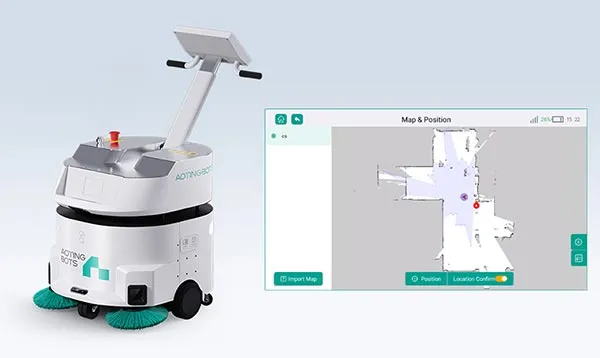
To understand the value of robotic systems, one must look at the underlying engineering. Unlike consumer-grade vacuums, industrial cleaning robots utilize SLAM (Simultaneous Localization and Mapping). This allows the machine to build a map of the environment and understand its location in real-time, even in dynamic warehouses where pallet positions change frequently.
For procurement managers and engineers, comparing autonomous systems to traditional manual scrubbers is essential for calculating the internal rate of return (IRR).
Warehouse floors are often treated with specialized epoxy or polished concrete to facilitate forklift movement. Accumulated dust and debris act as abrasives, accelerating tire wear on AGVs and forklifts. Regular robotic cleaning preserves the Coefficient of Friction (CoF) of the floor, extending the life of vehicle fleets and reducing floor maintenance costs over a 10-year horizon.
Robots also optimize resource consumption. Modern units feature water recycling systems that filter used water, allowing for extended run times without manual refills. This is particularly critical in facilities exceeding 50,000 square meters where the transit time back to a water station represents significant "dead time."
The effectiveness of these systems is best observed in high-traffic 3PL (Third-Party Logistics) environments. In these scenarios, the floor is never truly empty. Autonomous robots must navigate around moving personnel and heavy machinery simultaneously.
According to documented warehouse case studies, facilities that integrate robotic cleaning see a marked improvement in dust management and air quality. For electronics or pharmaceutical warehouses, where particulate control is a regulatory requirement, the ability to schedule multiple daily cleaning cycles is a major compliance advantage.
Managing a fleet of robots requires an understanding of "Opportunity Charging." Industrial robots are often programmed to return to a docking station when the battery hits a specific threshold or when the facility enters a high-peak window. This ensures the robot never becomes an obstacle in a narrow aisle with a dead battery.
From a manufacturing consultant’s perspective, the commercial value of a warehouse cleaning robot isn't found in just "replacing a janitor." It is found in the total reduction of operational risk.
Risk Mitigation: Reducing slip-and-fall incidents lowers insurance premiums and legal liabilities.
Uptime Optimization: Clean floors reduce sensor errors on other autonomous vehicles (like AGVs) that rely on clear floor markings.
Scalability: As the facility grows, adding a second or third robot to the digital map is simpler than recruiting and training a new cleaning crew in a tight labor market.
How does a warehouse cleaning robot handle forklift traffic?
Industrial robots utilize a multi-layered sensor stack, including LiDAR and 3D ToF cameras. When a forklift is detected, the robot can either slow down, stop, or calculate a new path in real-time to avoid a collision.
Can these robots clean in narrow aisles?
Yes. Modern autonomous scrubbers are designed with a tight turning radius specifically for VNA (Very Narrow Aisle) environments. They can clean right up to the edge of the racking without risking impact.
What is the typical ROI for a warehouse cleaning robot?
While it varies by facility size, most 3PL and large distribution centers see a return on investment within 12 to 18 months through labor savings, reduced chemical waste, and lower vehicle maintenance costs.
Do I need to change my warehouse layout to accommodate the robot?
Generally, no. SLAM technology allows robots to adapt to existing layouts. However, keeping floors clear of large debris (like discarded shrink wrap or broken pallets) is a best practice to ensure the robot operates at peak efficiency.
ISO 13482:2014: Robots and robotic devices — Safety requirements for personal care robots (Service Robots).
ASTM F45: New standards for evaluating the performance of automated floor cleaning robots.
OSHA 1910 Subpart D: Walking-Working Surfaces standards regarding floor cleanliness and safety.
IEEE Robotics and Automation Society: Technical whitepapers on SLAM and industrial autonomous navigation.
SGS/UL Certifications: Safety and battery management standards for industrial hardware.
In the landscape of modern logistics, facility maintenance has transitioned from a peripheral task to a strategic operational pillar. For high-throughput distribution centers, the cleanliness of the floor directly impacts safety, vehicle longevity, and overall "LEAN" manufacturing efficiency. Implementing a warehouse cleaning robot addresses the inherent limitations of manual labor, providing a scalable solution for 24/7 industrial environments.
Large warehouses present unique challenges, including high-density racking, constant forklift traffic, and diverse debris types. Robotic systems utilize advanced sensor suites to navigate these complexities, ensuring that hygiene standards remain consistent without disrupting the flow of goods.
The primary driver for robotic adoption in logistics is the need for consistent, predictable cleaning performance. Manual cleaning often suffers from "coverage gaps"—areas missed due to operator fatigue or inconsistent pathing. In contrast, an autonomous system follows a mathematically optimized route every time.
Key warehouse cleaning robot benefits include:
Continuous Productivity: Robots can operate during "lights-out" shifts or low-traffic periods without requiring overtime pay.
Operational Safety: Advanced obstacle avoidance reduces the risk of slip-and-fall accidents and collisions in high-traffic aisles.
Data-Driven Reporting: Integrated IIoT systems provide "proof of clean" reports, allowing facility managers to track hygiene KPIs digitally.
Strategic Labor Allocation: Human staff are freed from repetitive floor scrubbing to focus on high-value tasks like detailed sanitization or facility repairs.
To understand the value of robotic systems, one must look at the underlying engineering. Unlike consumer-grade vacuums, industrial cleaning robots utilize SLAM (Simultaneous Localization and Mapping). This allows the machine to build a map of the environment and understand its location in real-time, even in dynamic warehouses where pallet positions change frequently.
For procurement managers and engineers, comparing autonomous systems to traditional manual scrubbers is essential for calculating the internal rate of return (IRR).
Warehouse floors are often treated with specialized epoxy or polished concrete to facilitate forklift movement. Accumulated dust and debris act as abrasives, accelerating tire wear on AGVs and forklifts. Regular robotic cleaning preserves the Coefficient of Friction (CoF) of the floor, extending the life of vehicle fleets and reducing floor maintenance costs over a 10-year horizon.
Robots also optimize resource consumption. Modern units feature water recycling systems that filter used water, allowing for extended run times without manual refills. This is particularly critical in facilities exceeding 50,000 square meters where the transit time back to a water station represents significant "dead time."
The effectiveness of these systems is best observed in high-traffic 3PL (Third-Party Logistics) environments. In these scenarios, the floor is never truly empty. Autonomous robots must navigate around moving personnel and heavy machinery simultaneously.
According to documented warehouse case studies, facilities that integrate robotic cleaning see a marked improvement in dust management and air quality. For electronics or pharmaceutical warehouses, where particulate control is a regulatory requirement, the ability to schedule multiple daily cleaning cycles is a major compliance advantage.
Managing a fleet of robots requires an understanding of "Opportunity Charging." Industrial robots are often programmed to return to a docking station when the battery hits a specific threshold or when the facility enters a high-peak window. This ensures the robot never becomes an obstacle in a narrow aisle with a dead battery.
From a manufacturing consultant’s perspective, the commercial value of a warehouse cleaning robot isn't found in just "replacing a janitor." It is found in the total reduction of operational risk.
Risk Mitigation: Reducing slip-and-fall incidents lowers insurance premiums and legal liabilities.
Uptime Optimization: Clean floors reduce sensor errors on other autonomous vehicles (like AGVs) that rely on clear floor markings.
Scalability: As the facility grows, adding a second or third robot to the digital map is simpler than recruiting and training a new cleaning crew in a tight labor market.
How does a warehouse cleaning robot handle forklift traffic?
Industrial robots utilize a multi-layered sensor stack, including LiDAR and 3D ToF cameras. When a forklift is detected, the robot can either slow down, stop, or calculate a new path in real-time to avoid a collision.
Can these robots clean in narrow aisles?
Yes. Modern autonomous scrubbers are designed with a tight turning radius specifically for VNA (Very Narrow Aisle) environments. They can clean right up to the edge of the racking without risking impact.
What is the typical ROI for a warehouse cleaning robot?
While it varies by facility size, most 3PL and large distribution centers see a return on investment within 12 to 18 months through labor savings, reduced chemical waste, and lower vehicle maintenance costs.
Do I need to change my warehouse layout to accommodate the robot?
Generally, no. SLAM technology allows robots to adapt to existing layouts. However, keeping floors clear of large debris (like discarded shrink wrap or broken pallets) is a best practice to ensure the robot operates at peak efficiency.
ISO 13482:2014: Robots and robotic devices — Safety requirements for personal care robots (Service Robots).
ASTM F45: New standards for evaluating the performance of automated floor cleaning robots.
OSHA 1910 Subpart D: Walking-Working Surfaces standards regarding floor cleanliness and safety.
IEEE Robotics and Automation Society: Technical whitepapers on SLAM and industrial autonomous navigation.
SGS/UL Certifications: Safety and battery management standards for industrial hardware.
CONTACT US
we aim to become a global leader in manufacturer space service robotics and artificial intelligence.


