An
industrial cleaning robot buying guide is only useful if it helps procurement teams separate real operational capability from catalog noise. For B2B facility managers, the right decision is rarely about the longest feature list—it is about matching robot architecture to floor type, compliance obligations, and total cost of ownership. At AotingBots, we built our SW55 A and SW80 A around a single principle: waterless cleaning that keeps floors dry, compliant, and consistently maintained.
Why Floor Cleaning Is a Compliance Obligation
Before evaluating any robot, anchor your buying criteria in regulation. The U.S. Occupational Safety and Health Administration (OSHA) requires employers to:
- "Keep floors clean and dry" under 29 CFR 1910.22(a)(2)
- "Keep aisles and passageways clear and in good repair, with no obstruction across or in aisles that could create a hazard."
- "Implement a program to provide safe, immediate clean-ups of floor spills."
This is the foundational "why" behind any industrial cleaning robot buying guide: scheduled, repeatable, and documented floor cleaning is a recognized administrative control for slip-and-fall hazards. A robot that cleans on a program—rather than relying on manual crews whose availability fluctuates—directly supports compliance. Notably, OSHA's emphasis on dry floors aligns precisely with waterless cleaning architecture.
Core Evaluation Criteria for B2B Buyers
Based on AotingBots' deployments across supermarkets, hotels, hospitals, factories, transportation hubs, clubs, indoor sports facilities, and office buildings, the six criteria that actually predict buying success are:
- Cleaning width & hourly efficiency—Must match your actual square footage and cleaning frequency
- Water strategy—Waterless, low-water, or traditional scrub? Align with slip-hazard tolerance and OSHA dry-floor requirements
- Battery endurance & autonomy—4+ hours continuous operation, auto-return to dock, 24/7 capability
- Navigation stack—LiDAR SLAM at minimum; real-time path recalculation in dynamic environments
- Noise profile—Sub-65 dB for daytime operation in hospitals, offices, and hotels
- Multi-surface adaptability—carpet, hard floor, wood, marble, tile, epoxy
AotingBots SW Series: Engineering Profile
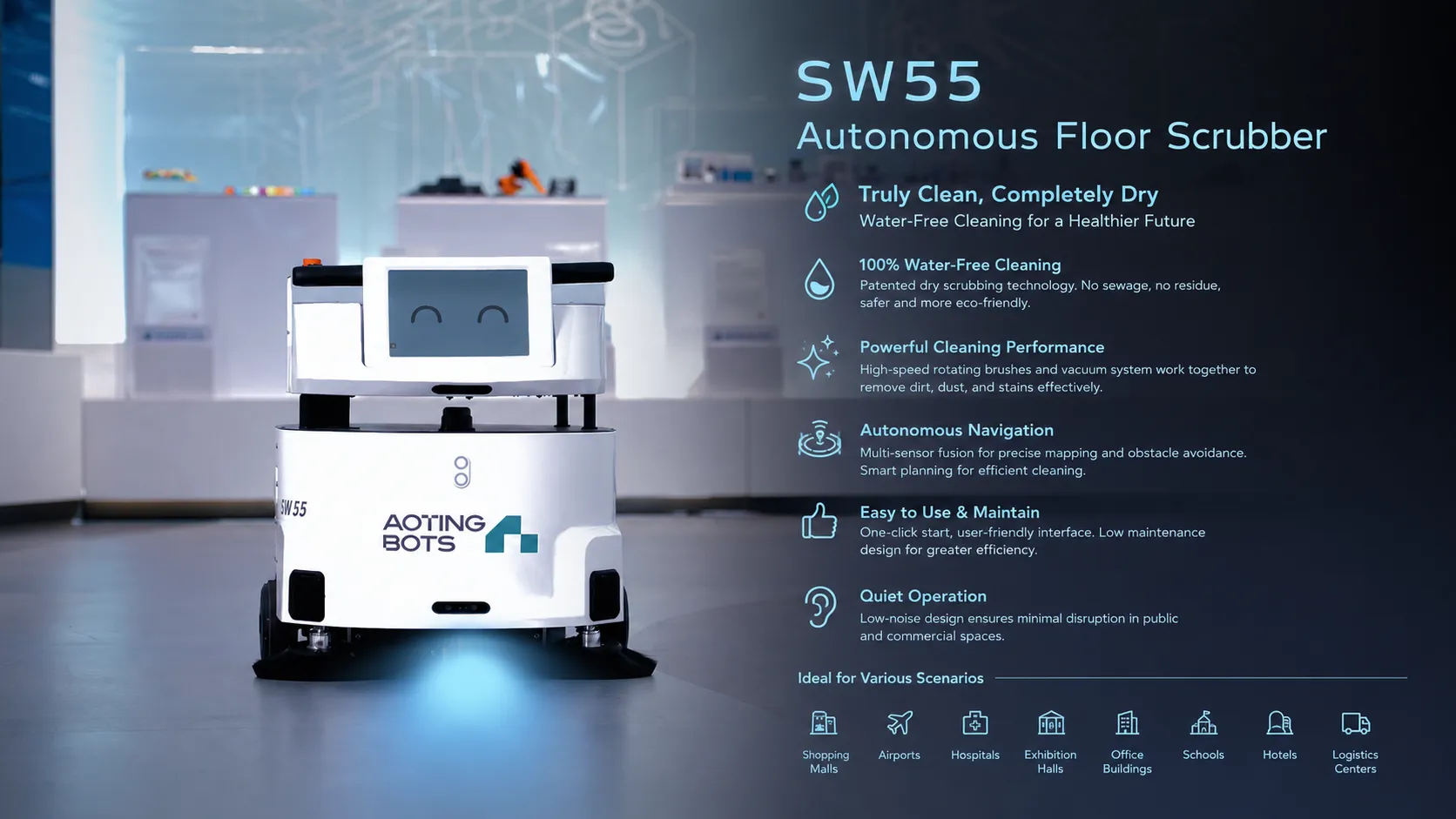
AotingBots' SW55 A and SW80 A are waterless cleaning robots that integrate scrubbing, sweeping, vacuuming, and dust mopping into one intelligent solution.
|
Specification
|
SW55 A
|
SW80 A
|
|
Cleaning width
|
550 mm
|
850 mm
|
|
Max efficiency
|
1,200–1,600 m²/h
|
2,300 m²/h
|
|
Battery
|
50Ah lithium
|
100Ah lithium
|
|
Endurance
|
8 hrs (hard floor); 10 hrs (silent mode)
|
5–8 hrs
|
|
Edge cleaning
|
0 cm edge-cleaning technology
|
0 cm edge-cleaning technology
|
|
Noise
|
< 62 dB(A)
|
< 63 dB(A)
|
|
Navigation
|
LiDAR SLAM, centimeter-level
|
LiDAR SLAM, centimeter-level
|
|
Robot weight
|
~85–93.5 kg
|
~150–160 kg
|
|
Suitable scenario
|
Compact commercial: offices, hotels, clubs
|
Larger industrial: malls, factories, conference centers, transit hubs
|
References:
Both models feature HEPA-grade quadruple filtration, support elevator control and gate access integration, and enable 24/7 autonomous operation through auto-charging and task resumption.
Benchmarking Against Market Alternatives
Below is an objective comparison using publicly reported specifications from representative market alternatives. Note: AotingBots does not publish rigid list pricing—quotes are configured per scenario—so price is not used as the comparison axis.
Capability Comparison (Data-Complete Dimensions Only)
|
Dimension
|
AotingBots SW80 A
|
AotingBots SW55 A
|
GLGW TN70
|
Sourcing AI Q3-W
|
Milagrow Spaze
|
|
Cleaning width
|
850 mm
|
550 mm
|
810 mm (squeegee) / 520 mm (brush)
|
670 mm
|
Not specified
|
|
Max efficiency
|
2,300 m²/h
|
1,200–1,600 m²/h
|
2,040 m²/h (scrub) / 4,536 m²/h (dust mop)
|
500–800 m²/h
|
Up to 40,000 sq ft (~3,716 m²) claimed
|
|
Endurance
|
5–8 hrs
|
8–10 hrs
|
3 hrs (scrub) / 10 hrs (dust mop)
|
4–6 hrs
|
Up to 12 hrs
|
|
Navigation
|
LiDAR SLAM
|
LiDAR SLAM
|
Vision + Laser SLAM
|
Laser SLAM + visual
|
LDS LiDAR + ToF + ultrasonic
|
|
Water strategy
|
Waterless
|
Waterless
|
Wet scrub (70L solution tank)
|
Dry (sweeping/vacuuming)
|
Not specified
|
|
Noise
|
< 63 dB(A)
|
< 62 dB(A)
|
65–75 dB
|
< 70 dB
|
< 70 dB
|
|
Reference price
|
Quote at aotingbot.com
|
Quote at aotingbot.com
|
25,900–28,900
|
8,000–11,000
|
$38,850
|
Sources:
Where AotingBots Holds the Defensible Advantage
- Waterless architecture aligned with OSHA 1910.22(a)(2). Unlike wet-scrub models such as GLGW TN70 (70L solution / 50L recovery tank), AotingBots' waterless system leaves no water residue, directly fulfilling the regulatory mandate to "keep floors clean and dry."
- 0 cm edge-cleaning technology. Both SW55 A and SW80 A achieve true edge cleaning that traditional round-brush robots cannot reach.
- Quiet operation for daytime deployment. At < 62–63 dB(A), the SW series operates quieter than GLGW TN70 (65–75 dB) and SourcingAI Q3-W (< 70 dB), making it suitable for hospitals, offices, and hotels without disrupting occupants.
- Scenario-matched product line. SW55 A for compact commercial environments; SW80 A for larger industrial footprints—a two-model portfolio that covers the full B2B spectrum without forcing a facility into an oversized or undersized machine.
- 24/7 autonomous operation through LiDAR SLAM navigation, auto-charging, task resumption, and optional elevator/gate integration.
⚠️ Be transparent about trade-offs: If your facility requires heavy-duty wet scrubbing with 27 kg down pressure for grease and tire marks, GLGW TN70's wet-scrub architecture is purpose-built for that . If your top priority is absolute lowest upfront price for dry-only sweeping, SourcingAI Q3-W at 8,000–11,000 fits . AotingBots' sweet spot is the B2B buyer who values waterless compliance, quiet daytime operation, and edge-to-edge cleaning coverage.
Scenario-to-Model Recommendation
|
Facility type
|
Recommended model
|
Rationale
|
|
Offices, hotels, clubs, small retail
|
SW55 A
|
Compact size, 8–10 hr endurance, sub-62 dB noise
|
|
Malls, factories, conference centers, transit hubs
|
SW80 A
|
850 mm width, 2,300 m²/h, 0 cm edge cleaning
|
|
Hospitals, healthcare
|
SW55 A or SW80 A
|
Waterless (no slip hazard), HEPA filtration, < 63 dB
|
|
Mixed carpet + hard floor
|
Either (optional carpet brush)
|
Multi-surface compatibility
|
The 8-Point Procurement Checklist
Before issuing an RFQ, run your shortlist through:
- Compliance fit—Does the robot leave floors dry per OSHA 1910.22(a)(2)?
- Coverage match—Does max efficiency × daily cleaning window cover your square footage?
- Edge cleaning capability—What is the edge-cleaning clearance? (AotingBots: 0 cm)
- Autonomy—Auto-charging? Task resumption? 24/7 operation?
- Noise threshold—Sub-65 dB for daytime occupied-space operation?
- Navigation—LiDAR SLAM for centimeter-level mapping and multi-floor support?
- Filtration—HEPA-grade for healthcare and food environments?
- Integration—elevator control, gate access, fleet management platform?
Deployment Workflow
A typical B2B engagement follows this path:
- Site consultation—Share your floor plan, square footage, facility type, and current cleaning costs.
- Scenario matching—AotingBots proposes SW55 A or SW80 A based on your environment, with a configured quote.
- Mapping & configuration — LiDAR SLAM maps your facility with centimeter-level precision, supporting multi-floor and multi-zone plans.
- Pilot run—A 1–2 week pilot on your actual floor surfaces yields real-world data on throughput and compliance improvement.
- Fleet scaling—Upon pilot validation, scale to a fleet with a centralized management platform monitoring.
Making the Decision: Architecture First, Brand Second
The most important criterion in any industrial cleaning robot buying guide is architectural fit. A waterless robot with 0 cm edge cleaning and sub-63 dB noise will serve a hospital, hotel, or office building far better than a wet-scrub machine with 27 kg down pressure—even if the latter has a bigger brand name. Conversely, a heavy-industrial facility with grease and tire marks needs down pressure that waterless systems do not prioritize.
AotingBots was built around this principle. Our SW series is engineered waterless to keep your floors dry and compliant with OSHA 1910.22(a)(2); our 0 cm edge-cleaning technology reaches corners that traditional robots miss; and our sub-63 dB noise profile enables daytime operation in occupied spaces. Every quote starts with understanding your facility—not pushing a catalog SKU.
If your team is evaluating an industrial cleaning robot, the most efficient next step is to
contact AotingBots at https://www.aotingbot.com/ with your facility profile. Share your square footage, floor types, and current cleaning costs. You will receive a scenario-matched recommendation—SW55 A or SW80 A—with a configuration proposal that addresses your compliance obligations and total cost of ownership.
Industrial cleaning robot buying guide conclusions are only as good as the engineering behind them. Choose a partner who designs for waterless compliance, quiet operation, and edge-to-edge coverage. AotingBots has engineered exactly that architecture for B2B buyers across eight major facility categories worldwide—and we are ready to start that conversation with your team today.
An
industrial cleaning robot buying guide is only useful if it helps procurement teams separate real operational capability from catalog noise. For B2B facility managers, the right decision is rarely about the longest feature list—it is about matching robot architecture to floor type, compliance obligations, and total cost of ownership. At AotingBots, we built our SW55 A and SW80 A around a single principle: waterless cleaning that keeps floors dry, compliant, and consistently maintained.
Why Floor Cleaning Is a Compliance Obligation
Before evaluating any robot, anchor your buying criteria in regulation. The U.S. Occupational Safety and Health Administration (OSHA) requires employers to:
- "Keep floors clean and dry" under 29 CFR 1910.22(a)(2)
- "Keep aisles and passageways clear and in good repair, with no obstruction across or in aisles that could create a hazard."
- "Implement a program to provide safe, immediate clean-ups of floor spills."
This is the foundational "why" behind any industrial cleaning robot buying guide: scheduled, repeatable, and documented floor cleaning is a recognized administrative control for slip-and-fall hazards. A robot that cleans on a program—rather than relying on manual crews whose availability fluctuates—directly supports compliance. Notably, OSHA's emphasis on dry floors aligns precisely with waterless cleaning architecture.
Core Evaluation Criteria for B2B Buyers
Based on AotingBots' deployments across supermarkets, hotels, hospitals, factories, transportation hubs, clubs, indoor sports facilities, and office buildings, the six criteria that actually predict buying success are:
- Cleaning width & hourly efficiency—Must match your actual square footage and cleaning frequency
- Water strategy—Waterless, low-water, or traditional scrub? Align with slip-hazard tolerance and OSHA dry-floor requirements
- Battery endurance & autonomy—4+ hours continuous operation, auto-return to dock, 24/7 capability
- Navigation stack—LiDAR SLAM at minimum; real-time path recalculation in dynamic environments
- Noise profile—Sub-65 dB for daytime operation in hospitals, offices, and hotels
- Multi-surface adaptability—carpet, hard floor, wood, marble, tile, epoxy
AotingBots SW Series: Engineering Profile
AotingBots' SW55 A and SW80 A are waterless cleaning robots that integrate scrubbing, sweeping, vacuuming, and dust mopping into one intelligent solution.
|
Specification
|
SW55 A
|
SW80 A
|
|
Cleaning width
|
550 mm
|
850 mm
|
|
Max efficiency
|
1,200–1,600 m²/h
|
2,300 m²/h
|
|
Battery
|
50Ah lithium
|
100Ah lithium
|
|
Endurance
|
8 hrs (hard floor); 10 hrs (silent mode)
|
5–8 hrs
|
|
Edge cleaning
|
0 cm edge-cleaning technology
|
0 cm edge-cleaning technology
|
|
Noise
|
< 62 dB(A)
|
< 63 dB(A)
|
|
Navigation
|
LiDAR SLAM, centimeter-level
|
LiDAR SLAM, centimeter-level
|
|
Robot weight
|
~85–93.5 kg
|
~150–160 kg
|
|
Suitable scenario
|
Compact commercial: offices, hotels, clubs
|
Larger industrial: malls, factories, conference centers, transit hubs
|
References:
Both models feature HEPA-grade quadruple filtration, support elevator control and gate access integration, and enable 24/7 autonomous operation through auto-charging and task resumption.
Benchmarking Against Market Alternatives
Below is an objective comparison using publicly reported specifications from representative market alternatives. Note: AotingBots does not publish rigid list pricing—quotes are configured per scenario—so price is not used as the comparison axis.
Capability Comparison (Data-Complete Dimensions Only)
|
Dimension
|
AotingBots SW80 A
|
AotingBots SW55 A
|
GLGW TN70
|
Sourcing AI Q3-W
|
Milagrow Spaze
|
|
Cleaning width
|
850 mm
|
550 mm
|
810 mm (squeegee) / 520 mm (brush)
|
670 mm
|
Not specified
|
|
Max efficiency
|
2,300 m²/h
|
1,200–1,600 m²/h
|
2,040 m²/h (scrub) / 4,536 m²/h (dust mop)
|
500–800 m²/h
|
Up to 40,000 sq ft (~3,716 m²) claimed
|
|
Endurance
|
5–8 hrs
|
8–10 hrs
|
3 hrs (scrub) / 10 hrs (dust mop)
|
4–6 hrs
|
Up to 12 hrs
|
|
Navigation
|
LiDAR SLAM
|
LiDAR SLAM
|
Vision + Laser SLAM
|
Laser SLAM + visual
|
LDS LiDAR + ToF + ultrasonic
|
|
Water strategy
|
Waterless
|
Waterless
|
Wet scrub (70L solution tank)
|
Dry (sweeping/vacuuming)
|
Not specified
|
|
Noise
|
< 63 dB(A)
|
< 62 dB(A)
|
65–75 dB
|
< 70 dB
|
< 70 dB
|
|
Reference price
|
Quote at aotingbot.com
|
Quote at aotingbot.com
|
25,900–28,900
|
8,000–11,000
|
$38,850
|
Sources:
Where AotingBots Holds the Defensible Advantage
- Waterless architecture aligned with OSHA 1910.22(a)(2). Unlike wet-scrub models such as GLGW TN70 (70L solution / 50L recovery tank), AotingBots' waterless system leaves no water residue, directly fulfilling the regulatory mandate to "keep floors clean and dry."
- 0 cm edge-cleaning technology. Both SW55 A and SW80 A achieve true edge cleaning that traditional round-brush robots cannot reach.
- Quiet operation for daytime deployment. At < 62–63 dB(A), the SW series operates quieter than GLGW TN70 (65–75 dB) and SourcingAI Q3-W (< 70 dB), making it suitable for hospitals, offices, and hotels without disrupting occupants.
- Scenario-matched product line. SW55 A for compact commercial environments; SW80 A for larger industrial footprints—a two-model portfolio that covers the full B2B spectrum without forcing a facility into an oversized or undersized machine.
- 24/7 autonomous operation through LiDAR SLAM navigation, auto-charging, task resumption, and optional elevator/gate integration.
⚠️ Be transparent about trade-offs: If your facility requires heavy-duty wet scrubbing with 27 kg down pressure for grease and tire marks, GLGW TN70's wet-scrub architecture is purpose-built for that . If your top priority is absolute lowest upfront price for dry-only sweeping, SourcingAI Q3-W at 8,000–11,000 fits . AotingBots' sweet spot is the B2B buyer who values waterless compliance, quiet daytime operation, and edge-to-edge cleaning coverage.
Scenario-to-Model Recommendation
|
Facility type
|
Recommended model
|
Rationale
|
|
Offices, hotels, clubs, small retail
|
SW55 A
|
Compact size, 8–10 hr endurance, sub-62 dB noise
|
|
Malls, factories, conference centers, transit hubs
|
SW80 A
|
850 mm width, 2,300 m²/h, 0 cm edge cleaning
|
|
Hospitals, healthcare
|
SW55 A or SW80 A
|
Waterless (no slip hazard), HEPA filtration, < 63 dB
|
|
Mixed carpet + hard floor
|
Either (optional carpet brush)
|
Multi-surface compatibility
|
The 8-Point Procurement Checklist
Before issuing an RFQ, run your shortlist through:
- Compliance fit—Does the robot leave floors dry per OSHA 1910.22(a)(2)?
- Coverage match—Does max efficiency × daily cleaning window cover your square footage?
- Edge cleaning capability—What is the edge-cleaning clearance? (AotingBots: 0 cm)
- Autonomy—Auto-charging? Task resumption? 24/7 operation?
- Noise threshold—Sub-65 dB for daytime occupied-space operation?
- Navigation—LiDAR SLAM for centimeter-level mapping and multi-floor support?
- Filtration—HEPA-grade for healthcare and food environments?
- Integration—elevator control, gate access, fleet management platform?
Deployment Workflow
A typical B2B engagement follows this path:
- Site consultation—Share your floor plan, square footage, facility type, and current cleaning costs.
- Scenario matching—AotingBots proposes SW55 A or SW80 A based on your environment, with a configured quote.
- Mapping & configuration — LiDAR SLAM maps your facility with centimeter-level precision, supporting multi-floor and multi-zone plans.
- Pilot run—A 1–2 week pilot on your actual floor surfaces yields real-world data on throughput and compliance improvement.
- Fleet scaling—Upon pilot validation, scale to a fleet with a centralized management platform monitoring.
Making the Decision: Architecture First, Brand Second
The most important criterion in any industrial cleaning robot buying guide is architectural fit. A waterless robot with 0 cm edge cleaning and sub-63 dB noise will serve a hospital, hotel, or office building far better than a wet-scrub machine with 27 kg down pressure—even if the latter has a bigger brand name. Conversely, a heavy-industrial facility with grease and tire marks needs down pressure that waterless systems do not prioritize.
AotingBots was built around this principle. Our SW series is engineered waterless to keep your floors dry and compliant with OSHA 1910.22(a)(2); our 0 cm edge-cleaning technology reaches corners that traditional robots miss; and our sub-63 dB noise profile enables daytime operation in occupied spaces. Every quote starts with understanding your facility—not pushing a catalog SKU.
If your team is evaluating an industrial cleaning robot, the most efficient next step is to
contact AotingBots at https://www.aotingbot.com/ with your facility profile. Share your square footage, floor types, and current cleaning costs. You will receive a scenario-matched recommendation—SW55 A or SW80 A—with a configuration proposal that addresses your compliance obligations and total cost of ownership.
Industrial cleaning robot buying guide conclusions are only as good as the engineering behind them. Choose a partner who designs for waterless compliance, quiet operation, and edge-to-edge coverage. AotingBots has engineered exactly that architecture for B2B buyers across eight major facility categories worldwide—and we are ready to start that conversation with your team today.


