
CONTACT US
SEARCH WHAT YOU WANT
Facility managers in warehouses, manufacturing plants, and large commercial spaces face a persistent challenge: maintaining clean, safe floors without inflating labor budgets. Industrial cleaning robot ROI has become a critical metric as autonomous floor cleaning systems mature from novelty to operational necessity. The question is no longer whether robots can clean—but whether the numbers justify the capital expenditure over a 3-to-5-year horizon.
Understanding the return on investment requires examining three interconnected variables: direct labor displacement, equipment lifecycle costs, and productivity gains from consistent cleaning quality. Each of these factors behaves differently depending on facility size, shift structure, and floor type. A 20,000-square-meter logistics hub running three shifts produces a fundamentally different ROI profile than a single-shift retail warehouse.
The ROI equation for autonomous cleaning equipment is driven by measurable operational shifts rather than abstract projections. Here are the primary cost and value drivers:
The financial picture also depends on depreciation treatment. Industrial cleaning robots typically qualify as capital equipment under MACRS 5-year depreciation schedules in the United States, or equivalent accelerated depreciation frameworks in other jurisdictions. This affects after-tax ROI calculations, particularly for large-scale deployments.
Payback period is the most straightforward ROI metric for facility decision-makers. It measures how long it takes for cumulative savings to recover the initial capital investment.
|
Cost Component |
Manual Cleaning (Annual) |
Robotic System (Annual) |
|
Labor (2 FTEs × 3 shifts) |
|
|
|
Equipment maintenance |
|
|
|
Consumables (detergent, pads) |
|
|
|
Training and onboarding |
|
|
|
Total annual operating cost |
|
|
Using a mid-range scenario: if a facility spends 180,000 annually on manual cleaning and transitions to a robotic system costing 65,000 per year to operate (including amortized equipment cost), the annual savings reach approximately 115,000. Against a typical industrial cleaning robot acquisition price of 45,000–$80,000, the payback period falls between 5 and 9 months.
That said, real-world payback periods vary. Facilities with simpler floor layouts and higher labor costs achieve faster returns. Complex environments with mixed flooring, narrow aisles, or heavy foot traffic may extend payback to 12–18 months as the robot requires more supervised operation during the learning phase.
A practical calculation workflow:
Not all facilities benefit equally from autonomous cleaning. ROI concentrates in environments with specific characteristics.
Large-format logistics and distribution centers are the strongest candidates. These facilities typically have 10,000–50,000 square meters of continuous hard flooring, predictable aisle layouts, and 24/7 operations where manual cleaning disrupts workflow. A robot with a 1,600 ㎡/h cleaning efficiency—such as the SW80-A—can cover a 20,000 ㎡ warehouse floor in roughly 12.5 hours of active cleaning, which fits within a single overnight shift including charging time.
Manufacturing plants benefit from consistent dust and debris control, particularly in industries where particulate contamination affects product quality. Food processing, electronics assembly, and pharmaceutical manufacturing all have documented cleaning protocols where repeatability directly impacts compliance outcomes.
Commercial and exhibition spaces present a different value proposition. These environments require cleaning during non-operational hours, making automation attractive. A conference center with 15,000 ㎡ of mixed carpet and hard flooring can deploy a single unit overnight, eliminating the need for a multi-person cleaning crew.
Facilities with carpet, hard flooring, and wooden surfaces in mixed configurations need a robot capable of surface adaptation. The SW80-A, for example, is engineered for all three floor types, which reduces the need for multiple specialized machines and simplifies maintenance scheduling.
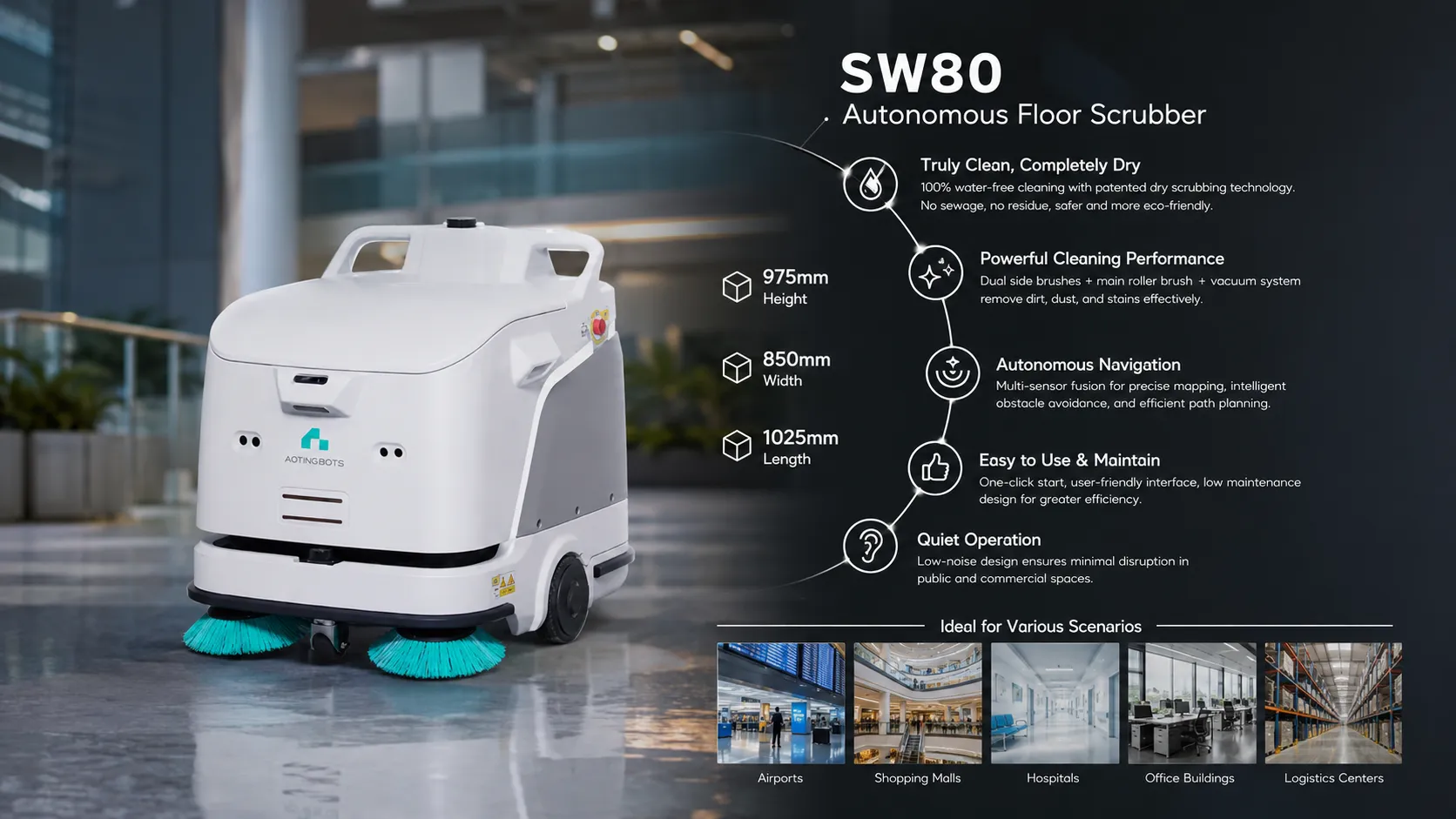
For facilities evaluating specific equipment, the SW80-A industrial cleaning robot from AotingBot provides a useful benchmark. Its specifications illustrate how hardware parameters translate into operational ROI:
|
Specification |
SW80-A Value |
ROI Implication |
|
Cleaning efficiency |
1,600 ㎡/h |
Covers ~12,800 ㎡ per 8-hour shift |
|
Battery endurance |
8h (hard floor), 12h (silent) |
Supports full-shift operation without mid-shift charging |
|
Max mapping area |
40,000 ㎡ |
Suitable for large warehouses and distribution hubs |
|
Cleaning path |
850 mm |
Wider path reduces total cleaning cycles per area |
|
Noise level |
≤62 dB(A) |
Permits daytime operation in occupied commercial spaces |
|
Charging time |
4 hours |
Enables two-shift operation with a single charge cycle |
|
Gradeability |
12% (7°) |
Handles ramped loading docks and mezzanine transitions |
|
Max vacuum power |
17 KPa |
Strong dust extraction for industrial debris profiles |
|
Floor compatibility |
Carpet, hard, wooden |
Eliminates need for multiple machines in mixed-floor facilities |
The SW80-A's 12-hour silent-mode endurance is particularly relevant for facilities that require continuous low-noise cleaning during operational hours—such as retail environments or healthcare-adjacent commercial spaces. The 62 dB(A) noise ceiling sits below typical conversational levels, meaning the robot can operate alongside workers without disruption.
From a procurement standpoint, the SW80-A's 40,000 ㎡ mapping ceiling means a single unit can serve most mid-to-large facilities. For warehouses exceeding this footprint, deploying two units in coordinated zones often remains more cost-effective than a single high-capacity ride-on machine with higher maintenance requirements.
When evaluating this or any similar system, procurement teams should request:
Several variables determine whether your actual payback period aligns with projections or drifts beyond expectations.
Floor complexity is the most underestimated factor. Wide-open warehouse floors with minimal obstacles allow robots to operate at maximum efficiency. Facilities with dense racking, irregular layouts, or frequent layout changes (common in fulfillment centers) may see efficiency drop by 15–25% as the robot navigates around obstacles.
Battery lifecycle management affects long-term ROI. Lithium-ion batteries in industrial cleaning robots typically retain 80% capacity after 1,000–1,500 charge cycles. At one cycle per day, that translates to 3–4 years before battery replacement becomes necessary. Replacement costs range from 2,000–5,000 depending on capacity, which should be factored into 5-year TCO models.
Supervisory labor is often overlooked. Even autonomous robots require a trained operator for startup, mapping updates, consumable refills, and basic troubleshooting. This role typically requires 2–4 hours per day, not a full-time position, but it represents a real cost that must appear in ROI calculations.
Cleaning quality consistency generates indirect ROI through reduced slip-and-fall incidents, improved audit scores, and extended floor lifespan. While harder to quantify, these benefits often represent 10–20% of total ROI in facilities with stringent safety or compliance requirements.
What is a typical payback period for an industrial cleaning robot?
Most facilities achieve payback between 6 and 18 months, depending on facility size, labor costs, and shift structure. Multi-shift operations with high local labor rates see the fastest returns, often under 9 months. Single-shift facilities in lower-wage markets may extend toward the upper end of that range.
How much does an industrial cleaning robot cost?
Acquisition prices for commercial-grade autonomous floor cleaners range from 35,000 to 90,000 depending on cleaning capacity, battery size, navigation sophistication, and brand. Mid-range units suitable for 10,000–30,000 ㎡ facilities typically fall between 45,000 and 70,000.
Can one robot replace an entire cleaning crew?
In large, single-floor facilities with predictable layouts, one unit can replace 1.5–2.5 full-time positions across multiple shifts. However, a human supervisor is still needed for consumable management, mapping updates, and maintenance. Complex or multi-floor facilities may require additional units or retain partial manual cleaning.
What maintenance does an industrial cleaning robot require?
Routine maintenance includes brush replacement (every 3–6 months), filter changes (monthly to quarterly), battery health monitoring, and sensor cleaning. Annual professional servicing is recommended. Most manufacturers offer service contracts ranging from 3,000–8,000 per year depending on coverage level.
Does the SW80-A work on all floor types?
Yes. The SW80-A is designed for carpet, hard flooring, and wooden surfaces. This multi-surface capability eliminates the need for separate machines in facilities with mixed flooring, which simplifies procurement and reduces total equipment investment.
Facility managers in warehouses, manufacturing plants, and large commercial spaces face a persistent challenge: maintaining clean, safe floors without inflating labor budgets. Industrial cleaning robot ROI has become a critical metric as autonomous floor cleaning systems mature from novelty to operational necessity. The question is no longer whether robots can clean—but whether the numbers justify the capital expenditure over a 3-to-5-year horizon.
Understanding the return on investment requires examining three interconnected variables: direct labor displacement, equipment lifecycle costs, and productivity gains from consistent cleaning quality. Each of these factors behaves differently depending on facility size, shift structure, and floor type. A 20,000-square-meter logistics hub running three shifts produces a fundamentally different ROI profile than a single-shift retail warehouse.
The ROI equation for autonomous cleaning equipment is driven by measurable operational shifts rather than abstract projections. Here are the primary cost and value drivers:
The financial picture also depends on depreciation treatment. Industrial cleaning robots typically qualify as capital equipment under MACRS 5-year depreciation schedules in the United States, or equivalent accelerated depreciation frameworks in other jurisdictions. This affects after-tax ROI calculations, particularly for large-scale deployments.
Payback period is the most straightforward ROI metric for facility decision-makers. It measures how long it takes for cumulative savings to recover the initial capital investment.
|
Cost Component |
Manual Cleaning (Annual) |
Robotic System (Annual) |
|
Labor (2 FTEs × 3 shifts) |
|
|
|
Equipment maintenance |
|
|
|
Consumables (detergent, pads) |
|
|
|
Training and onboarding |
|
|
|
Total annual operating cost |
|
|
Using a mid-range scenario: if a facility spends 180,000 annually on manual cleaning and transitions to a robotic system costing 65,000 per year to operate (including amortized equipment cost), the annual savings reach approximately 115,000. Against a typical industrial cleaning robot acquisition price of 45,000–$80,000, the payback period falls between 5 and 9 months.
That said, real-world payback periods vary. Facilities with simpler floor layouts and higher labor costs achieve faster returns. Complex environments with mixed flooring, narrow aisles, or heavy foot traffic may extend payback to 12–18 months as the robot requires more supervised operation during the learning phase.
A practical calculation workflow:
Not all facilities benefit equally from autonomous cleaning. ROI concentrates in environments with specific characteristics.
Large-format logistics and distribution centers are the strongest candidates. These facilities typically have 10,000–50,000 square meters of continuous hard flooring, predictable aisle layouts, and 24/7 operations where manual cleaning disrupts workflow. A robot with a 1,600 ㎡/h cleaning efficiency—such as the SW80-A—can cover a 20,000 ㎡ warehouse floor in roughly 12.5 hours of active cleaning, which fits within a single overnight shift including charging time.
Manufacturing plants benefit from consistent dust and debris control, particularly in industries where particulate contamination affects product quality. Food processing, electronics assembly, and pharmaceutical manufacturing all have documented cleaning protocols where repeatability directly impacts compliance outcomes.
Commercial and exhibition spaces present a different value proposition. These environments require cleaning during non-operational hours, making automation attractive. A conference center with 15,000 ㎡ of mixed carpet and hard flooring can deploy a single unit overnight, eliminating the need for a multi-person cleaning crew.
Facilities with carpet, hard flooring, and wooden surfaces in mixed configurations need a robot capable of surface adaptation. The SW80-A, for example, is engineered for all three floor types, which reduces the need for multiple specialized machines and simplifies maintenance scheduling.
For facilities evaluating specific equipment, the SW80-A industrial cleaning robot from AotingBot provides a useful benchmark. Its specifications illustrate how hardware parameters translate into operational ROI:
|
Specification |
SW80-A Value |
ROI Implication |
|
Cleaning efficiency |
1,600 ㎡/h |
Covers ~12,800 ㎡ per 8-hour shift |
|
Battery endurance |
8h (hard floor), 12h (silent) |
Supports full-shift operation without mid-shift charging |
|
Max mapping area |
40,000 ㎡ |
Suitable for large warehouses and distribution hubs |
|
Cleaning path |
850 mm |
Wider path reduces total cleaning cycles per area |
|
Noise level |
≤62 dB(A) |
Permits daytime operation in occupied commercial spaces |
|
Charging time |
4 hours |
Enables two-shift operation with a single charge cycle |
|
Gradeability |
12% (7°) |
Handles ramped loading docks and mezzanine transitions |
|
Max vacuum power |
17 KPa |
Strong dust extraction for industrial debris profiles |
|
Floor compatibility |
Carpet, hard, wooden |
Eliminates need for multiple machines in mixed-floor facilities |
The SW80-A's 12-hour silent-mode endurance is particularly relevant for facilities that require continuous low-noise cleaning during operational hours—such as retail environments or healthcare-adjacent commercial spaces. The 62 dB(A) noise ceiling sits below typical conversational levels, meaning the robot can operate alongside workers without disruption.
From a procurement standpoint, the SW80-A's 40,000 ㎡ mapping ceiling means a single unit can serve most mid-to-large facilities. For warehouses exceeding this footprint, deploying two units in coordinated zones often remains more cost-effective than a single high-capacity ride-on machine with higher maintenance requirements.
When evaluating this or any similar system, procurement teams should request:
Several variables determine whether your actual payback period aligns with projections or drifts beyond expectations.
Floor complexity is the most underestimated factor. Wide-open warehouse floors with minimal obstacles allow robots to operate at maximum efficiency. Facilities with dense racking, irregular layouts, or frequent layout changes (common in fulfillment centers) may see efficiency drop by 15–25% as the robot navigates around obstacles.
Battery lifecycle management affects long-term ROI. Lithium-ion batteries in industrial cleaning robots typically retain 80% capacity after 1,000–1,500 charge cycles. At one cycle per day, that translates to 3–4 years before battery replacement becomes necessary. Replacement costs range from 2,000–5,000 depending on capacity, which should be factored into 5-year TCO models.
Supervisory labor is often overlooked. Even autonomous robots require a trained operator for startup, mapping updates, consumable refills, and basic troubleshooting. This role typically requires 2–4 hours per day, not a full-time position, but it represents a real cost that must appear in ROI calculations.
Cleaning quality consistency generates indirect ROI through reduced slip-and-fall incidents, improved audit scores, and extended floor lifespan. While harder to quantify, these benefits often represent 10–20% of total ROI in facilities with stringent safety or compliance requirements.
What is a typical payback period for an industrial cleaning robot?
Most facilities achieve payback between 6 and 18 months, depending on facility size, labor costs, and shift structure. Multi-shift operations with high local labor rates see the fastest returns, often under 9 months. Single-shift facilities in lower-wage markets may extend toward the upper end of that range.
How much does an industrial cleaning robot cost?
Acquisition prices for commercial-grade autonomous floor cleaners range from 35,000 to 90,000 depending on cleaning capacity, battery size, navigation sophistication, and brand. Mid-range units suitable for 10,000–30,000 ㎡ facilities typically fall between 45,000 and 70,000.
Can one robot replace an entire cleaning crew?
In large, single-floor facilities with predictable layouts, one unit can replace 1.5–2.5 full-time positions across multiple shifts. However, a human supervisor is still needed for consumable management, mapping updates, and maintenance. Complex or multi-floor facilities may require additional units or retain partial manual cleaning.
What maintenance does an industrial cleaning robot require?
Routine maintenance includes brush replacement (every 3–6 months), filter changes (monthly to quarterly), battery health monitoring, and sensor cleaning. Annual professional servicing is recommended. Most manufacturers offer service contracts ranging from 3,000–8,000 per year depending on coverage level.
Does the SW80-A work on all floor types?
Yes. The SW80-A is designed for carpet, hard flooring, and wooden surfaces. This multi-surface capability eliminates the need for separate machines in facilities with mixed flooring, which simplifies procurement and reduces total equipment investment.
CONTACT US
we aim to become a global leader in manufacturer space service robotics and artificial intelligence.


